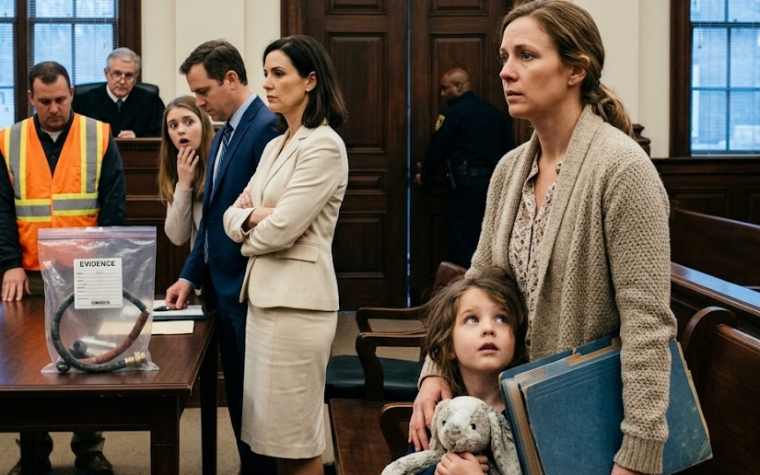
My attorney opened the leather file across his knees, and for the first time that morning, nobody in my family seemed to know what to say.
Gary remained halfway up the porch steps.
One hand still rested on the railing, but the confidence had gone out of his posture.
Dana held the colored-tab folder against her chest.
Victor stood behind them beside the moving truck, his mouth slightly open.
The two hired movers stayed near the driveway.
They had arrived expecting furniture.
Instead, they were watching a family realize it had witnesses.
My attorney did not raise his voice.
“Before anyone removes anything from this property,” he said, “I would like to see the authority you’re relying on.”
Dana recovered first.
She always did.
Her expression softened into concern, the same careful face she used whenever she wanted to frame herself as the reasonable person in the room.
“There’s been a misunderstanding,” she said.
“We’re her parents.
She’s eighteen as of yesterday.
We’re helping her manage an estate she clearly isn’t prepared to handle alone.”
Then she held out the folder.
My attorney did not take it immediately.
“Did she ask you to come here with a moving truck?”
Dana’s eyes flicked toward me.
“She authorized management.”
“That wasn’t my question.”
Gary came up another step.
“We’re not doing a courtroom routine on the porch.
She signed the paperwork.
We have every right to be here.”
I looked at him and remembered what I had heard six hours earlier through the cracked kitchen window.
She will.
She always folds when it gets emotional.
I had spent most of my childhood thinking silence meant losing.
That morning, I began to understand that silence could also mean letting someone finish making the mistake.
My attorney finally took Dana’s folder.
He opened it slowly.
The first page was the management authorization I had seen from the upstairs window.
My name appeared beneath several paragraphs of legal language, and beneath that was the signature.
It was good.
That was the frightening part.
Whoever had copied it knew how I looped the first letter and shortened the last stroke when I was rushing.
It looked enough like mine that, without anything else, I might have spent weeks fighting over whether I had signed it.
My attorney studied it for several seconds.
Gary mistook his silence for uncertainty.
“There,” he said.
“Now can we stop pretending something criminal is happening?”
Victor gave a thin laugh.
“Exactly.
She’s overwhelmed.
That’s why adults are handling it.”
I was standing in my grandfather’s robe with bare feet inside old house shoes, my hair unbrushed, facing three adults who had arrived before breakfast to tell me I was too young to control what had legally been left to me.
For years, that difference in appearance would have been enough to make me doubt myself.
That morning, it made their performance look ridiculous.
My attorney turned to the second page.
Then the third.
Finally, he looked at me.
“Did you sign this?”
“No.”