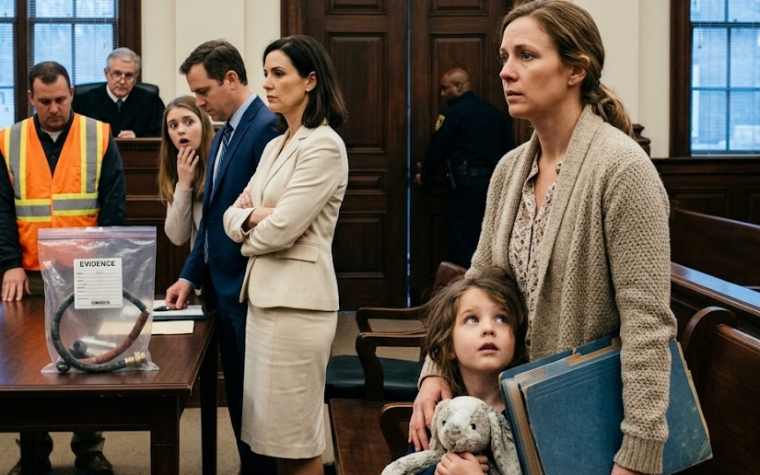
Adrian stood in the doorway staring at the first page of the court folder as if the words had physically struck him.
Celeste leaned over his shoulder.
“What is it?”
He did not answer.
Two days earlier, he had stood beside my hospital bed with absolute certainty that he controlled everything: the money, the house, the lawyers, the timing, even the version of our marriage that would survive after he abandoned me.
Now his hand tightened around a stack of papers he had never expected to receive.
The first order temporarily restricted either of us from selling, transferring, hiding, or further encumbering major marital assets while the divorce was being reviewed.
The second required preservation of financial records.
The third concerned temporary access to the marital home and the circumstances surrounding the transfer to Celeste.
Nothing on that porch declared me the winner.
It did something Adrian feared more.
It stopped him from moving faster than the truth.
His phone rang less than ten minutes later.
His lawyer had received the same filings.
According to my father, Adrian’s first response was exactly what we expected.
Anger.
He insisted the house transfer was legitimate.
He insisted Celeste legally owned it.
He insisted I had no right to interfere with property he considered his to control.
His confidence lasted until the questions began.
When had the transfer been prepared?
When had it been signed?
What consideration had Celeste paid?
Why had the transaction occurred while his wife was hospitalized giving birth to their three children?
Why had proposed divorce and custody papers already been prepared when he entered my hospital room?
Why had he changed the locks before I had even recovered enough to care for three newborns without assistance?
The timing, which Adrian had considered clever, suddenly became evidence.
I was staying with my parents when my father explained it to me.
The triplets slept nearby in three bassinets arranged across the guest room.
My mother had taken the night shift with me, feeding one baby while I held another and the third slept against a rolled blanket beside us.
I was exhausted enough to forget what day it was.
My father sat across from me with copies of Adrian’s paperwork spread over the table.
“You need to understand something,” he said.
“We cannot erase what he did.
We can make sure he has to explain it.”
That distinction mattered.
My parents were not going to solve my marriage by shouting louder than Adrian.
They had spent decades building businesses, negotiating contracts, and dealing with people who confused aggression with power.
When I was younger, I had sometimes resented how carefully my father documented everything.
Now every question he asked had a purpose.
He did not ask whether Adrian was cruel.
We already knew that.
He asked for dates.
Bank statements.
Messages.
Photographs of the folder from the hospital.
A copy of the house transfer.
The date the locks had been changed.
The name of the hospital.
The names of anyone who had witnessed Adrian bringing the paperwork into my room.
I thought of the nurse.
She had appeared only briefly, but she had seen enough.
My attorney contacted the hospital through the proper process, and the nurse later confirmed that she had seen Adrian standing at my bed with another woman while legal papers were spread across my blanket.
She remembered my condition.
She remembered the bassinets.
She remembered Adrian dismissing her with the words “Private family matter.”