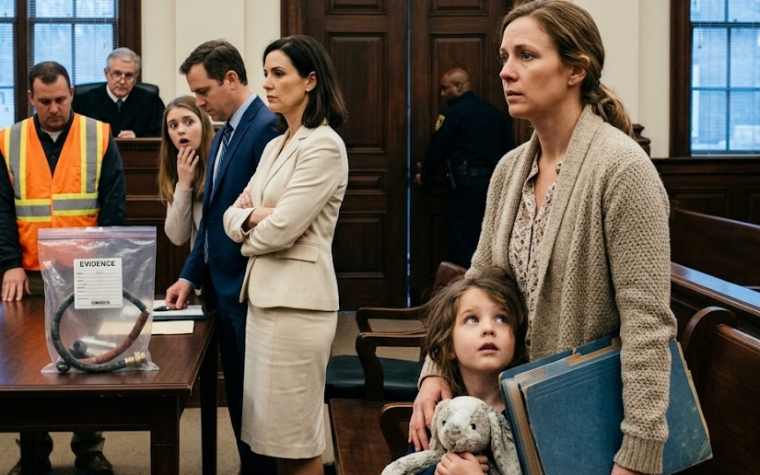
Lily opened the folder.
Grant’s face changed before he could stop it.
It was not dramatic.
No gasp.
No stumble.
Just the smallest loss of color beneath the confidence he wore like a tailored suit.
That was enough for me.
For twenty-eight years, I had watched witnesses, attorneys, defendants, executives, officers, and experts walk into federal court believing they could control a room through confidence alone.
The ones who depended most heavily on performance often revealed themselves in tiny moments: a tightened jaw, a glance toward an exit, a hand suddenly too still.
Grant looked at the folder.
Then at Lily.
Then at me.
“What is this?” he asked.
Lily’s fingers shook against the cardboard edge, but she did not close it.
Her attorney, a woman who had no professional connection to me and no reason to fear Grant, stepped closer to Lily’s side.
“It’s documentation relevant to the petition,” she said.
Grant’s smile returned.
“Petition.”
He gave a quiet laugh, as if someone had told a joke beneath his intelligence.
Then he looked directly at Lily.
“So this is what we’re doing?”
That tone mattered.
Not angry enough for strangers to call it anger.
Not loud enough for anyone to intervene.
But Lily heard what lived underneath it.
Her shoulders tightened.
I saw it.
Her attorney saw it too.
“We’re going inside,” she said.
Grant stepped half a pace toward Lily.
“You really want to destroy our marriage in public?”
Lily’s attorney moved between them.
“Do not approach my client.”
His eyes sharpened.
Then he noticed two courthouse officers farther down the hall and immediately relaxed his posture.
“Of course,” he said.
The transformation was instant.
That was Grant’s gift.
He always knew when someone important might be watching.
What he had failed to understand was that Lily had finally started watching too.
The folder was not magical.
It did not contain some secret document capable of ending his career with one dramatic flourish.
Real life rarely works that way.
It contained something more dangerous to a man who depended on controlling the story.
A timeline.
Photographs of Lily’s injuries taken the night she came home.
Notes written while her memory was fresh.
The names of people who had seen her immediately before and after the firm dinner Grant blamed for his rage.
Messages Lily had saved instead of deleting.
And, most importantly, Lily’s own account in her own words.
Not mine.
Not a federal judge’s interpretation.
Hers.
That distinction mattered to me more than Grant could have understood.
I had no intention of turning my office into a weapon for my daughter.
I would not call judges.