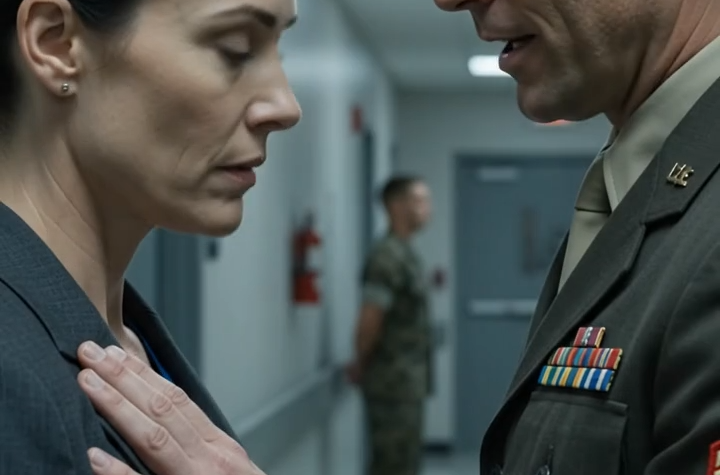
Admiral Helena Cross opened the folder beneath my bouquet, shielding its contents from the guests while the final applause faded through the chapel.
The first page carried the name of my father’s company: Vale Maritime Systems.
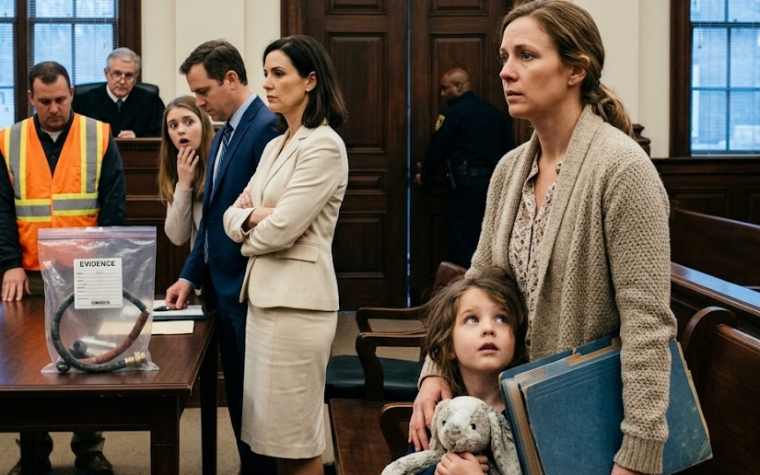
Below it was a photograph of a warped metal housing recovered from the ship where the explosion had nearly killed me.
I recognized the blackened serial plate immediately.
I had seen it through smoke on the Arabian Sea, moments before the fire-suppression system failed.
My father stood at the rear of the chapel, staring at the folder as if it were a weapon pointed at his chest.
The organist began the processional before anyone could notice the silence between the admiral and me.
Admiral Cross closed the file.
“Not here,” she murmured.
“This moment still belongs to you.”
Then she escorted me the rest of the way to Daniel.
The wedding ceremony proceeded beneath the stained-glass windows, but the world felt divided into two separate realities.
In one, Daniel held my hands and promised to stand beside me in sickness, health, peace, and uncertainty.
His voice shook only once, when his thumb brushed the scar along my wrist.
In the other, my father sat in the final pew with his shoulders locked and his eyes fixed on the sealed folder resting beside Admiral Cross.
Camille sat next to him.
She whispered something twice, but he did not answer.
When Daniel placed the ring on my finger, I looked at the man I had chosen rather than the man who had rejected me.
“I do,” I said.
For the first time that day, my voice did not tremble.
Daniel kissed me while the chapel erupted again.
The officers applauded.
The politicians smiled for the cameras.
My father remained seated until Camille pulled sharply at his sleeve.
He rose too late.
The wedding photograph was taken on the chapel steps immediately afterward.
Daniel stood on my right.
Admiral Cross stood on my left.
My father hovered beyond the photographer’s frame, waiting for someone to invite him forward.
No one did.
He had been terrified that history would remember him standing beside my scars.
Instead, the first permanent image of the day captured his absence.
A naval security officer approached Admiral Cross after the photograph and spoke quietly.
She gave a single nod, then guided Daniel and me into a private room beside the chapel office.
The room was small, with a wooden table, four chairs, and a narrow window overlooking the reception garden.
The admiral placed the investigation file on the table.
Daniel shut the door.
“What did his company supply?” he asked.
Admiral Cross did not soften her answer.
“Thermal isolation housings used in emergency power and fire-control systems.
Vale Maritime Systems won the contract five years ago.
Their components were installed on multiple vessels.”
She opened the folder and turned the first photograph toward us.
The housing had split along one side.
Its internal seal had melted into a dark, brittle line.
“The initial explosion aboard your ship began in a fuel-transfer compartment,” she continued.
“Your father’s equipment did not cause the first ignition.
But the emergency system was supposed to isolate the damaged section and activate suppression within seconds.”
“It didn’t,” I said.
“No.
The housing failed under heat levels it had supposedly survived during certification.”
I stared at the photograph.
During the explosion, I had reached the control passage just as the emergency lights died.
The bulkhead doors had stalled halfway closed.
Flames had rushed through the gap with enough force to throw me against the wall.
Three sailors had been trapped beyond that door.