Marcus Reed stared at Serena Hayes’s right eyelid.
For three nights he had entered Room 814 with a cleaning cart, changed liners, wiped counters, and tried not to listen to the wealthy visitors who spoke around the motionless woman as though she were furniture.
Now her eyelid had moved twice.
Marcus leaned closer.
“Ms.
Hayes, if that was you, do it one more time.”
Serena concentrated until pain seemed to gather behind her forehead.
Move.
Please move.
Her eyelid twitched.
Marcus stumbled backward so quickly his hip struck the cleaning cart.
He didn’t run to Robert Mitchell.
He didn’t call the company’s lawyer.
He stepped into the hallway and found the nearest nurse.
“She can hear us,” he said.
The nurse looked toward Serena’s room.
“Mr.
Reed—”
“Ask her yourself.”
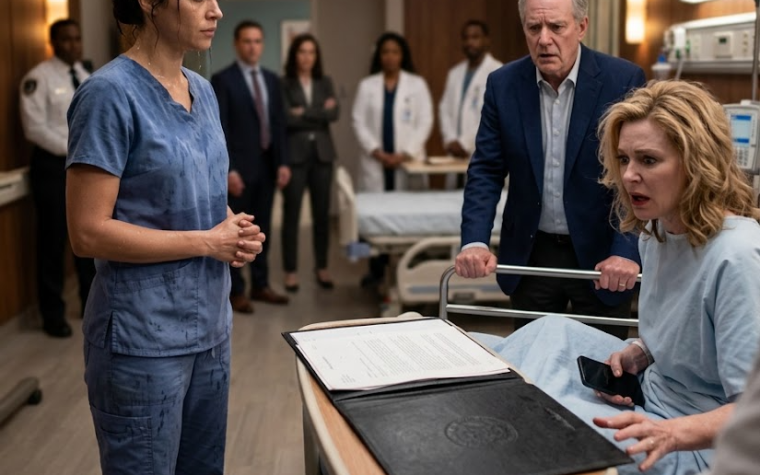
The nurse entered reluctantly, checked Serena’s monitors, then leaned over the bed.
“Serena, if you understand me, try to blink once.”
Nothing happened for several seconds.
Serena could feel panic rising.
She had spent days hearing people decide what her silence meant.
Now, when someone finally asked her directly, her body threatened to betray her again.
She forced herself toward the tiny movement she had discovered.
Her right eyelid fluttered.
The nurse froze.
She asked another question.
“Blink once if your name is Serena Hayes.”
One blink.
“Blink twice if you’re in pain.”
Two slow movements followed.
Within minutes, the room changed.
A physician arrived.
Then another.
The casual voices disappeared.
Questions became deliberate.
Serena was examined for signs of awareness that had been missed because her injuries had left her almost completely unable to respond.
The conclusion did not restore her body, but it restored something nearly as important.
They believed her.
Serena was conscious.
Her condition resembled locked-in syndrome: her mind remained alert while severe paralysis prevented ordinary movement and speech.
The tiny control around one eye gave the medical team a way to communicate with her.
For Serena, one blink became yes.
Two became no.
It was primitive, exhausting, and painfully slow.
It was also power.
Marcus remained by the doorway while the doctors worked.
He could have left when his shift ended, but Serena watched the blurred shape of him whenever she managed to open her eye a fraction.
Eventually a nurse asked, “Do you want Mr.
Reed to stay?”
One blink.
Marcus swallowed hard.
“Okay,” he said.
“I’m here.”