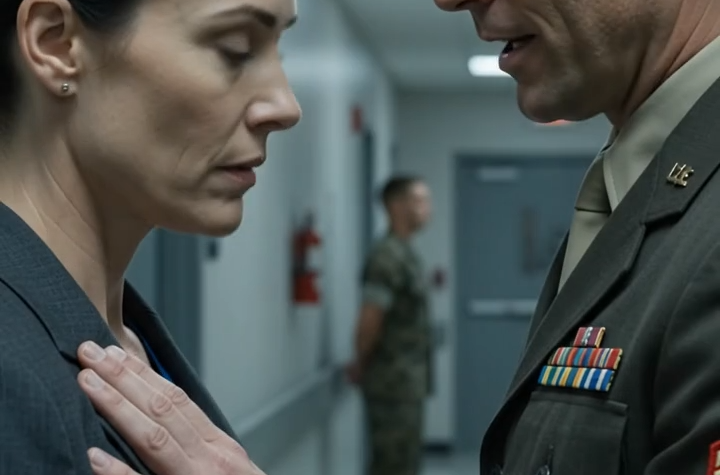
General Rowan opened the black folder, and for the first time that morning, Garrett Cole’s mother had nothing to say.
I could not see the entire page from where I stood, but I recognized the format immediately.
Official designation forms.
Emergency instructions.
Beneficiary records.
Documents soldiers completed before assignments from which they might not return.
The general compared the serial number on the folder with the sealed envelope in my hand.
“They match,” he said.
Scarlett stepped away from the casket.
“What matches?”
General Rowan turned so his voice carried across the cemetery.
“Before his final mission, Garrett Cole submitted written instructions concerning his military honors, personal effects, and surviving dependents.
Those instructions were verified forty-eight hours before deployment.”
Garrett’s mother recovered enough to speak.
“There must be some mistake.
My son would never leave his final wishes with her.”
She pointed at me as though I were an intruder rather than the mother of his three children.
The general’s expression did not change.
“Captain Mercer is not receiving these honors as his former spouse.”
Scarlett exhaled in relief.
Then the general continued.
“She is receiving the flag as the legal guardian of Garrett Cole’s three eldest children, whom he identified as his primary next of kin.”
The silence that followed was so complete I could hear rain tapping against the casket.
My daughter looked from the flag to me.
“Is that for us?” she whispered.
I lowered myself until we were eye to eye.
“Yes,” I said.
“It is for you.”
Scarlett’s hand dropped from her stomach.
“I’m carrying his child.”
“No one is disputing that,” General Rowan replied.
“Any rights belonging to that child will be protected through the proper legal process.
But you are not Garrett Cole’s widow.”
A murmur moved through the mourners.
Scarlett glanced toward the cameras.
Until that moment, every photograph had framed her as the woman Garrett left behind.
Her black veil, her hand on the coffin, her carefully placed chair beside his parents—all of it had been arranged around a title she did not possess.
“We were going to be married,” she said.
Garrett’s father stepped forward.
“They were practically married.”
“Practically is not a legal status,” the general said.
My former mother-in-law’s face hardened.
“Alex has no right to humiliate this family.”
I stood again.
“I have not said a word about your family.”
“You came here in uniform to make a spectacle of yourself.”
“I wore my uniform because I was ordered to report to General Rowan.”
That was when I understood the handwritten message on the envelope.
Bring to Arlington.
It had not been a request.
General Rowan looked toward his aide.
The younger officer removed a small encrypted audio device from the folder.
It had no visible screen, only a speaker and a metal authentication seal.
Garrett’s mother took one step backward.
“What is that?”
“Your son’s final recorded statement,” the general said.