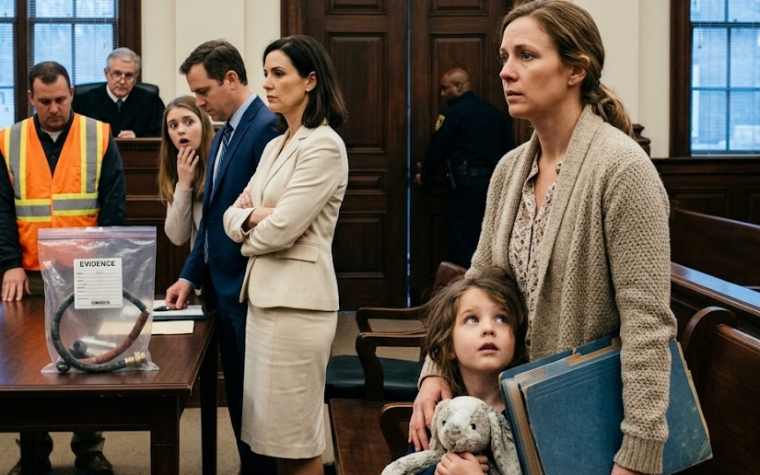
The chair kept his eyes on the first page of Kieran’s folder.
The senior man reached for it, but the chair moved it out of his reach.
“What exactly am I looking at?” he asked.
Kieran folded her hands on the table.
She had imagined this moment several times during the weeks she spent making marks in the margins of agendas, but she had never imagined herself making a speech.
The evidence did not need one.
“Every interruption in the meetings I attended,” she said.
“Who spoke.
Who was cut off.
Who interrupted.
Whether the unfinished point returned later, and who received credit when it did.”
The man gave a short laugh.
“You kept a secret scorecard on your colleagues?”
“I kept a record of the room.”
“That’s not research.
That’s resentment.”
Kieran looked at the pen still resting near his hand.
He had used it to tap the table while she spoke, to signal impatience before he interrupted, and to point at her proposal when he announced that he would take over.
Now the tapping had stopped.
The chair turned the page.
The first section contained only dates, speaking turns, and marks.
The names were not dramatic.
The pattern was.
In one meeting, Kieran had been interrupted five times before finishing a single explanation.
In another, a woman presenting financial risks had been stopped twice, only for the same warning to be repeated by a man fourteen minutes later.
The minutes credited him with identifying the problem.
A third meeting showed Kieran proposing the exact strategy the senior man had just been praised for clarifying.
The chair looked toward the colleague responsible for taking minutes.
“Is this accurate?”
The colleague hesitated.
That hesitation was its own answer.
“The timestamps can be checked,” Kieran said.
“So can the drafts.”
The senior man sat forward.
“This is absurd.
Meetings are not court transcripts.
People overlap.
People get excited.
We finish each other’s thoughts.”
“Not equally,” Kieran said.
He opened his mouth.
The chair lifted one hand before he could speak.
It was a small gesture, but everyone noticed it.
For once, the interruption had been stopped before it landed on her.
Kieran continued.
She told them about the two researchers at UC Santa Barbara who, in 1975, decided to stop describing conversational imbalance as a feeling and measure it instead.
They observed 31 ordinary conversations between men and women.
They counted 48 interruptions.
Forty-seven came from men.
No one at the table moved.
“One study from the seventies proves nothing about this office,” the man said.
“I agree that one study should not carry forty years of explanation,” Kieran replied.
“That’s why I counted again.”
She directed the chair to the next section of the folder.
For weeks, she had tracked every interruption in every professional meeting she attended.
She had not begun with the assumption that men would dominate the count.