The doors closed behind him.
For several seconds, no one spoke.
Then Reverend Whitaker sank onto the pulpit step.
The authority seemed to leave his body before the breath did.
He looked older than he had that morning, his shoulders bent beneath the weight of every word he had spoken.
“I thought I was protecting this church,” he said.
Grace answered quietly.
“You were protecting yourself from their judgment.”
He looked toward the congregation.
Nobody contradicted her.
Caleb retrieved the marriage certificate and offered it to Grace.
“You decide what happens next.”
She folded the paper carefully and placed it inside her dress, over the place where Nathaniel had once found Caleb’s letter.
Then she walked out through the center aisle.
Caleb followed one pace behind.
Her father did not ask her to stop.
Outside, cold air struck Grace’s face.
The street was lined with horses, wagons, and townspeople who had been unable to fit inside the church.
News had already begun passing between them.
Caleb waited until they reached the church gate before speaking.
“I should have returned sooner.”
Grace shook her head.
“You came when the letter reached you.”
“It reached me six days ago.
I spent four gathering the records and two persuading the magistrate that the Vale name was not evidence of innocence.”
A tired smile touched her mouth.
“Was he difficult to persuade?”
“Until I showed him the cuff link.”
Grace looked back at the church.
Through the windows, she could see her father still sitting on the pulpit step.
“I thought Nathaniel might burn it,” she said.
Caleb understood she did not mean the letter.
“We have deputies watching the Vale property,” he told her.
“And Augustus now knows that any fire will be treated as evidence.”
Grace exhaled for what felt like the first time in a month.
She did not collapse into Caleb’s arms.
She did not suddenly become unafraid.
Survival did not leave her body merely because Nathaniel had been taken away.
But she allowed Caleb to place her hand through his arm, and together they walked toward the boardinghouse where he had taken a room.
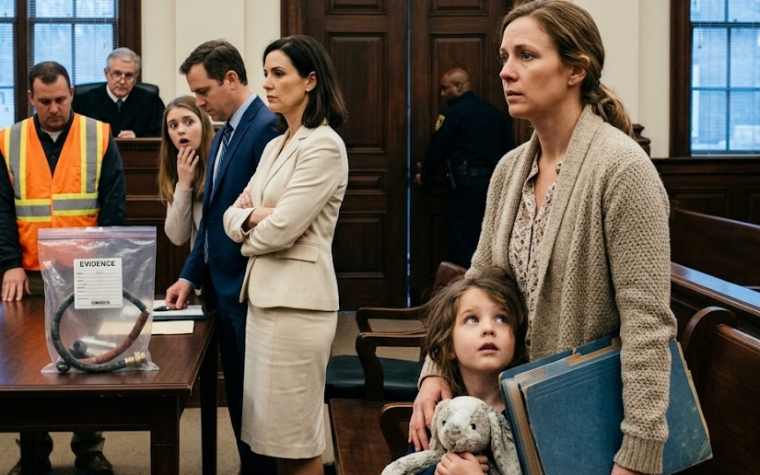
The legal fight lasted through the winter.
Nathaniel denied everything at his first hearing.
At the second, he claimed Grace had attacked him.
By the third, he insisted Caleb had invented the marriage to steal money from Augustus.
Each story contradicted the one before it.
The county physician testified that Grace’s injuries matched restraint and a blade held against her side.
The festival witnesses repeated what they had seen.
The miner Nathaniel struck in church described his attempt to flee.
Then the magistrate ordered the church testimony entered into the record.
Nathaniel’s own words—his knowledge of the shed, the torn cuff, and the pregnancy—did what his father’s money could not undo.
Grace testified on the final day.
Nathaniel’s attorney asked why she had stayed silent.
She looked directly at the jurors.
“Because he threatened the people I loved, and because every powerful man in Black Hollow had taught me that his word would weigh more than mine.”
The attorney asked whether her secret marriage proved she was capable of deception.
Grace answered, “It proves I knew the difference between privacy and a lie.”
The courtroom went quiet.