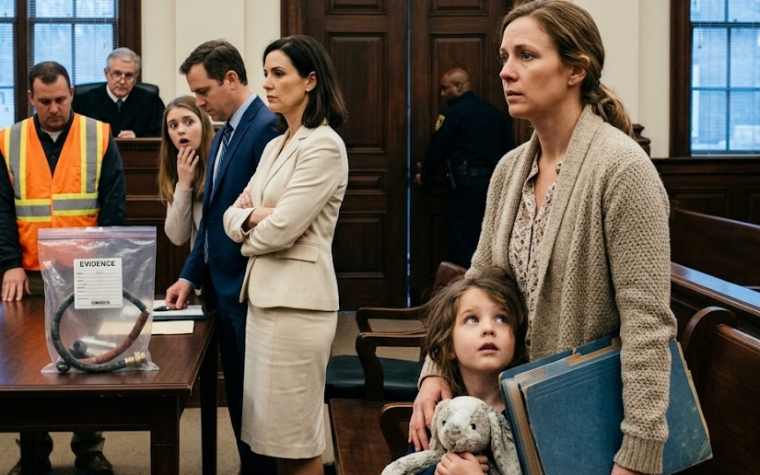
Amber opened the folder again.
Nothing inside had magically changed.
There was no secret check waiting between the pages, no mysterious benefactor, no document promising that everything would suddenly be easy.
There was something more useful than that.
There was a record.
For days, Amber had experienced each setback as a separate blow.
Anthony blocked her access to the accounts and financial resources.
Dave refused to help.
Then the lawyer explained that without payment, representation could not continue.
Emotionally, it had felt like the whole world had turned against her at once.
On the table, however, events could be put in order.
Amber began with the oldest papers and worked forward.
She made one pile for documents connected to the case itself.
Another for financial material already included in the file.
A third for correspondence and notes.
She was careful not to pretend she understood things she didn’t understand.
Every time legal language became confusing, she set that page aside rather than guessing.
But she understood dates.
And she understood cause and effect.
Anthony’s decision to block her access to money had not merely made her uncomfortable.
It had affected her ability to continue paying the lawyer who was handling her case.
That fact had seemed humiliating in the lawyer’s office.
Written down, it seemed important.
Amber took a blank sheet of paper and wrote a simple sequence.
Access to money stopped.
Legal fees became impossible to pay.
Representation ended.
Pressure to give up increased.
She stared at the final line.
That was the part Anthony could not see from wherever he was.
Amber had almost called him.
She had almost decided that returning to him was the only practical choice left.
Now, surrounded by the files, she realized she had been treating desperation like a verdict.
It wasn’t one.
It was a condition.
Conditions could change.
The next morning, Amber carried the files with her instead of leaving them on the table.
She still had no lawyer beside her.
She still had no sudden access to the accounts.
Dave had not changed his mind.
The disadvantages were real.
But Amber no longer allowed herself to translate the word difficult into impossible.
She started by finding out what she could do without paid representation while the case remained unresolved.
She asked procedural questions rather than pretending to know legal answers.
She learned where documents could be submitted, what information she needed to keep organized, and which requests had to be made formally rather than through arguments with Anthony.
None of it felt dramatic.
There were forms.
Copies.
Dates.
Instructions.
Waiting.
For Amber, that ordinary process became its own form of resistance.
Anthony had controlled something she needed: access to financial resources.
Amber could not simply reverse that herself.
What she could do was stop treating Anthony as the only person with the authority to decide what happened next.
When Anthony eventually learned that Amber was continuing with the case despite losing her lawyer, his confidence showed immediately.