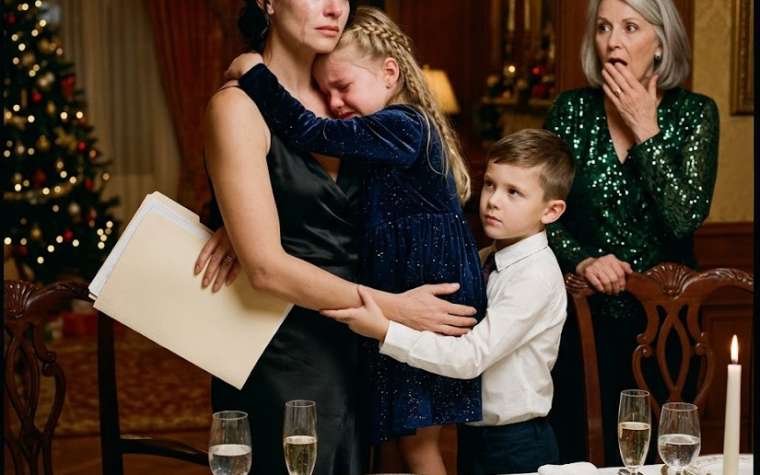
The challenge did not produce the result he expected.
Sophie’s records were meticulous.
Mr.
Halloway had preserved the execution documents, witness statements, competency confirmation, trust records, property deed, and her correspondence about the proposed financial papers Marcus had wanted her to sign.
There was no dramatic courtroom confession.
There did not need to be.
Paper was enough.
Marcus’s lawyer eventually advised him that attacking Sophie’s mental capacity without evidence would be expensive and unlikely to succeed.
The house remained in Sophie’s estate structure and then passed according to her trust instructions.
Marcus was required to remove his belongings within the lawful period established during the estate process.
I did not stand on the lawn when he left.
I did not need that moment.
Mr.
Halloway handled the arrangements.
Josephine disappeared from Marcus’s life almost immediately.
Whether she left because of the money, the humiliation, or finally seeing exactly what kind of man she had chosen, I never asked.
It no longer mattered.
Months later, I entered Sophie’s house alone.
Her mug was still in the kitchen cabinet.
A cardigan hung over the back of a chair.
Near the window was the little spot where she used to stand and call me whenever rain tapped against the glass.
That nearly destroyed me in a way Marcus never could.
I sat at her kitchen table and opened the folder Mr.
Halloway had given me after the estate was settled.
Inside were copies of the documents Sophie had saved, along with one handwritten note I had never seen.
It contained only a few lines.
She wrote that she had spent too long believing keeping peace was the same as protecting a family.
Then she wrote, “I want my child to inherit something better than fear.”
I pressed the paper to my chest.
Sophie never got to raise that child.
I never got to become the grandmother I had expected to be.
No will could repair that.
No legal victory could turn grief into justice.
But Marcus had wanted Sophie’s final chapter to be one of helplessness.
He had walked into her funeral believing death had silenced the only person standing between him and everything he wanted.
He was wrong.
Sophie’s final decisions spoke with extraordinary clarity.
The memorial fund created through her trust eventually began helping women obtain counseling, emergency support, and independent legal advice during difficult pregnancies and family crises.
I kept the work quiet because Sophie would have preferred it that way.
On the first anniversary of her death, I returned to the cemetery carrying white lilies.
I placed them beside her stone and stood there for a long time.
I thought about Marcus’s entrance into the chapel.
Josephine’s red nails.
Her whispered declaration.
The cruel confidence of two people who believed the absence of resistance meant they had already won.
Then I remembered Sophie’s letter.
My silence near the end was not weakness.
That was the daughter I wanted to remember.
Not the betrayed wife.
Not the young mother whose future had ended too soon.
Sophie was the woman who finally understood that she did not have to announce every boundary for it to exist.
She did not have to win an argument to protect herself.
She did not have to convince Marcus that she knew the truth.
She simply acted.
Quietly.
Legally.