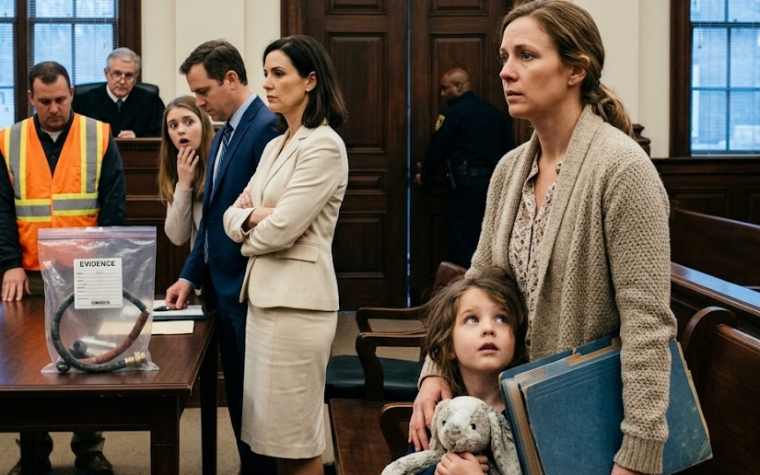
I am asking the court to protect my children from being treated like property.”
The judge looked toward Nick.
He stared at the table.
The temporary protection order remained in place.
Nick received no control over Adeline’s medical decisions and no unsupervised access to the babies after birth until the investigations and a full custody evaluation were completed.
The court also ordered him to restore medical coverage and release funds sufficient for Adeline’s care, though Lucien had already guaranteed every hospital expense.
Outside the courtroom, Nick attempted one final performance for the cameras.
He spoke about family unity and false accusations.
Then investigators approached him with a warrant concerning the medical-data breach.
His executive assistant had confessed that Nick personally ordered the scan accessed.
The assistant had preserved the voice message.
The recording ended Nick’s performance.
Within a week, Drayke Holdings placed him on leave.
The family trustees opened an internal investigation into his attempt to use unborn children to secure voting control.
Investors who had tolerated rumors about his marriage reacted differently to documented fraud and misuse of private medical information.
Sienna provided investigators with the second phone and ended her relationship with him publicly.
She did not ask Adeline for forgiveness, and Adeline did not offer it.
Some wounds did not require a dramatic reconciliation.
They required distance.
The divorce agreement was set aside.
A new settlement returned Adeline’s share of the marital assets and imposed penalties for concealed accounts.
Nick later accepted a plea agreement related to the unlawful medical access and financial coercion.
He avoided prison but received probation, substantial fines, and a permanent record that followed him into every boardroom he once controlled.
His contact with the children remained supervised.
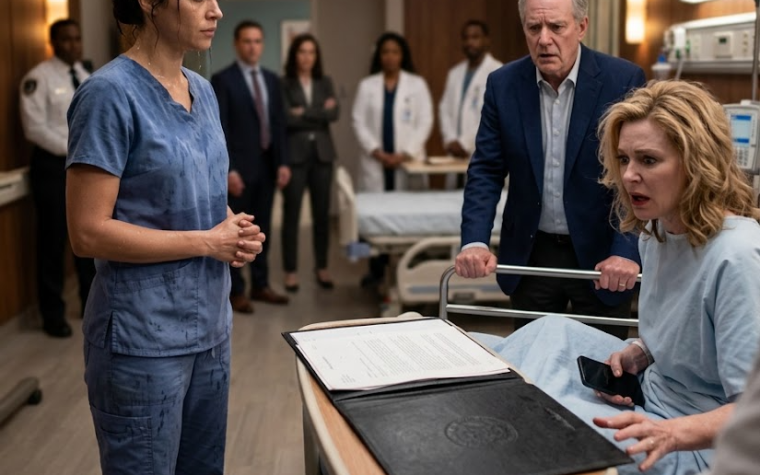
Three months after the night on the bridge, Adeline delivered two girls and a boy by planned surgery at Arkwright Medical Center.
They were small, furious, and healthy enough to fill the room with three distinct cries.
Lucien waited outside until Adeline asked the nurse to bring him in.
He stopped at the doorway as though crossing it required more courage than any corporate battle he had fought.
Adeline held one daughter against her chest.
The other two babies slept beneath warm blankets.
“They need names for the birth certificates,” she said.
Lucien smiled carefully.
“Have you chosen them?”
“Elise, after my mother.
Noah, because he survived the storm.
And Hope, because I nearly lost mine.”
Lucien turned away for a moment, pressing his fingers against his eyes.
Adeline watched him without pretending the lost years had vanished.
He could not return her childhood.
She could not instantly become the daughter he remembered searching for.
But he had arrived when the bus driver would not stop.
He had carried her through the rain without asking what she could give him.
Most importantly, when she told him her choices were her own, he listened.
Months later, Adeline moved into a home she selected and purchased with money recovered from the divorce.
It was not Lucien’s mansion, though he offered it.
It had a small garden, wide windows, and enough space for three cribs beside one another.
She resumed her work as an interior designer from a studio overlooking the garden.
Lucien visited on Sundays.
He learned how to warm bottles, accepted instructions from the nanny without argument, and discovered that none of his influence could persuade three infants to sleep at the same time.
Nick appeared only during court-approved visits.
Without assistants, lawyers, or cameras, he seemed smaller.
Adeline did not celebrate that.
She simply enforced every boundary the court had established.
One afternoon, as rain tapped softly against the windows, she opened the black folder Lucien had brought to the hospital.
She kept the cruel divorce clause inside, but not as evidence of what Nick had taken.
She kept it as proof of the moment his certainty began to collapse.