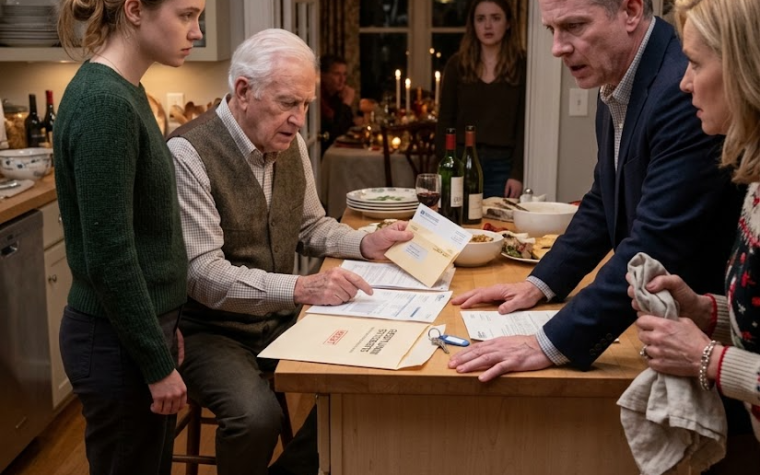
“She signed paper,” my grandfather replied.
“That is not the same as signing away the law.”
One of the officers asked Weston to surrender the folder.
He pulled it against his chest.
“This belongs to me.”
“It may contain evidence of financial coercion against a patient,” the captain said.
“You will leave it with hospital legal counsel until copies can be made.”
Weston took a step toward my chair instead.
“You planned this,” he hissed.
“You lied to me for three years.”
I looked at Sawyer’s tiny hand curled beneath the incubator light.
“I protected my privacy.
You concealed a mistress, emptied our accounts while I was unconscious, and abandoned your children in intensive care.”
“That company is mine,” he snapped.
“Everything I have came from my work.”
“Then you should have no difficulty proving it without stealing from our joint accounts.”
Ashley touched his arm.
“Weston, let’s go.”
He shook her off.
“No.
She thinks some rich relative can humiliate me.” He pointed at my grandfather.
“You cannot interfere with my marriage because you donated a wing to this hospital.”
My grandfather’s expression did not change.
“I did not donate the wing.”
Weston waited.
“I own Beacon Health Holdings.
Beacon Health Holdings owns this hospital and eleven others.”
The room became so quiet that I could hear the soft rush of oxygen through the twins’ equipment.
Ashley’s face lost its color.
Weston looked from my grandfather to me.
“You said you had a small trust.”
“I do.”
“How small?”
“That was never your concern.”
His disbelief became fury.
He lunged toward my phone, perhaps intending to seize it or end the call history before anyone could examine it.
He never reached me.
Two officers caught him by the arms.
Weston twisted, shouting that he was the father and that no one could remove him from his own children.
The captain reminded him that being a parent did not grant permission to threaten a patient or disrupt medical care.
Ashley tried to follow, still wrapped in my coat.
A female officer stopped her at the doorway.
“The coat stays.”
Ashley looked at Weston for help, but he was already being pulled backward into the corridor.
With an angry jerk, she unfastened the buttons and let the coat slide from her shoulders.
She threw it toward my chair.
My grandfather caught it before it touched the floor.
Then security escorted her out after Weston.
When he tried to wrench free near the elevator, the officers tightened their hold and dragged him through the closing doors.
Ten minutes earlier, he had stood over me as though I had no power, no home, and no witness.
Now the folder remained on the nurse’s counter, my coat rested across my grandfather’s arm, and every person in the unit had heard enough to understand exactly who Weston was.
I expected to feel triumphant.
Instead, I began shaking.
The nurse crouched beside me and checked my pulse.
My grandfather placed the coat over the back of the chair, careful not to let it brush against my incision.
“You do not have to be strong for the next five minutes,” he said.