He laughed.
Then his voice softened.
“Mom?”
“Yeah?”
“Thanks.”
I knew what he meant.
Not thanks for the detergent lesson.
Not thanks for showing him how to wash a plate.
Not even thanks for the folder.
He was thanking me for refusing to let comfort become helplessness.
Children are not at home to be served.
They are there to be loved, protected, guided, and prepared.
That preparation includes ordinary work.
A child who cleans their room is learning more than where clothes belong.
They are learning that their environment responds to their choices.
A child who washes a plate learns that using something creates a responsibility to care for it.
A child who helps maintain a shared home learns that other people’s time matters too.
Chores are not valuable because adults enjoy assigning them.
They are valuable because adulthood is filled with unglamorous responsibilities nobody applauds.
There will be no audience when the trash needs taking out.
No reward when a bathroom needs cleaning.
No medal for keeping track of clean clothes, groceries, appointments, belongings, and the thousand small tasks that hold an ordinary life together.
But learning to handle those things creates something larger than cleanliness.
It creates capability.
Discipline.
Respect.
Gratitude.
And eventually, independence.
My son once believed I was taking away a piece of his childhood every time I handed him a broom, pointed toward a laundry basket, or asked him to clean his plate.
What I was really trying to give him was a future in which he didn’t need another person to organize his life for him.
When children are young, we do many things for them because they cannot do those things themselves.
As they grow, love has to change shape.
Sometimes love stops tying the shoe and teaches the knot.
Sometimes love stops carrying the plate and points toward the sink.
Sometimes love sees the clothes on the floor and leaves them there long enough for the person who dropped them to understand they belong to him.
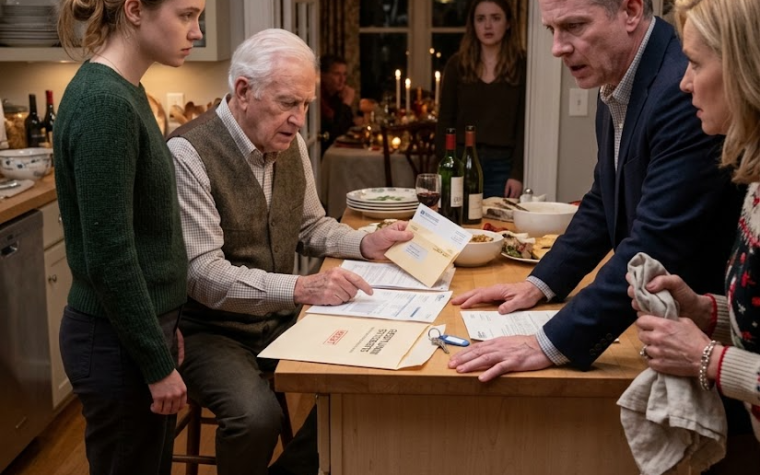
And sometimes love opens a folder at a silent dinner table and allows a seventeen-year-old boy to discover that independence is not the absence of responsibility.
It is the moment responsibility finally becomes your own.
On the day he left, my son carried his last box to the door.
Then he stopped, looked back at his empty room, and noticed a single sweatshirt lying on the floor.
He walked back, picked it up, folded it, and placed it in the box.
Neither of us said anything.
We didn’t need to.
For years, I had wondered whether all those reminders had mattered.
That small gesture answered me.
The boy who once expected someone else to pick up after him was walking into the world understanding that no one else was responsible for keeping his life in order.
And that was never a punishment.
It was one of the most useful forms of love I knew how to give him.