Your board gets stability.”
“And me?”
“You learn to share power.”
He gave a humorless laugh.
“You enjoy this.”
“No.”
And I meant it.
“I wish you had simply been kind.”
That landed harder than anything else I had said.
William signed two days later.
Not because I defeated him.
Because his board read the same documents I had read and understood that the revised terms were better than collapse.
Several of his business partners supported the changes.
The man who had once dominated every discussion suddenly had to answer questions before decisions were made.
There was no dramatic public ruin.
No police cars.
No screaming headlines.
Just consequences.
Real ones.
The kind that lasted longer than humiliation.
Quinn did not speak to his father for several weeks.
I never asked him to choose between us.
I told him I would not build a relationship around an ultimatum.
He told me he was not choosing between people.
He was choosing what behavior he was willing to stand beside.
Eventually, William asked to meet us for coffee.
No country club.
No private dining room.
No audience.
He arrived early.
He apologized again, this time without conditions.
He did not mention the deal.
He did not mention my money.
He said he had spent his life believing hardship made people lesser because admitting otherwise would mean acknowledging that privilege had made many things easier for him.
I did not forgive him immediately.
Forgiveness is not a receipt someone receives after saying the correct sentence.
But I listened.
Months later, Quinn and I attended another family dinner.
Smaller table.
Fewer guests.
No performance.
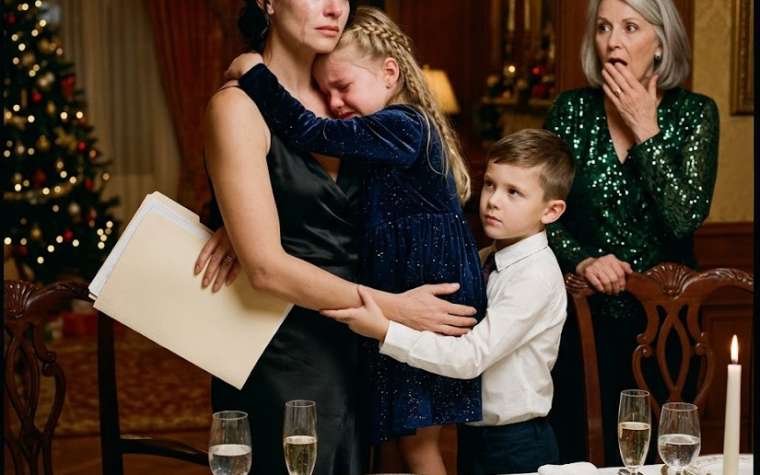
Quinn’s mother placed a napkin beside my plate, and for a moment I remembered folding another one beneath that chandelier.
I remembered twenty-three silent faces.
I remembered walking past the expensive painting and into the cold night while William believed he had put me in my place.
The strangest part was that he had.
Just not the place he intended.
He reminded me that I had spent too many years surviving rooms where people assumed dignity was something they could grant or withdraw.
I had survived shelters, free lunches, warehouse shifts, classrooms after midnight, and every closed door that came before Cross Meridian.
None of those things embarrassed me.
They built me.
William had looked at that history and seen garbage.
I looked at it and saw evidence.
Evidence that I knew how to endure without becoming cruel.
Evidence that I could hold power without needing to humiliate someone with less.
Evidence that the borrowed dress had never been the most valuable thing I brought into his house.
At the end of dinner, William caught my eye across the table.