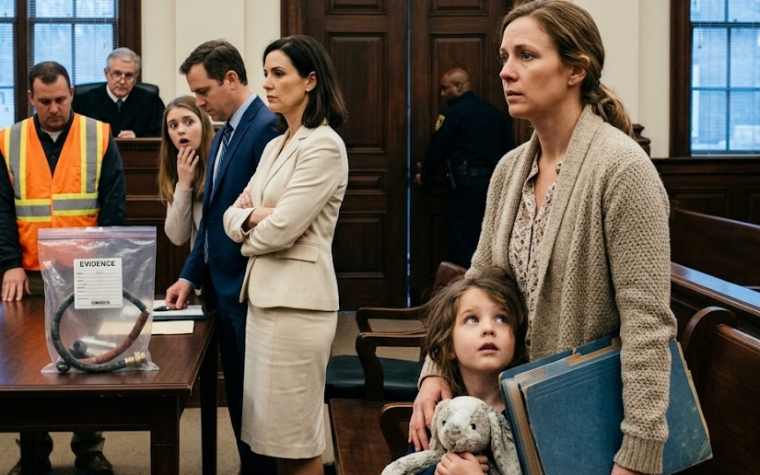
The judge’s thumb slid beneath the first black tab.
Evan remained standing until the bailiff stepped closer to his table.
Only then did he lower himself into the chair.
His movements were stiff and careful, as though sitting slowly could stop the page from turning.
The document on top was titled Reed Family Continuity Trust.
The lettering meant little by itself.
The date beneath it meant everything.
Evan had created the trust five months before our son was born—during the same period he later claimed we had been separated and he had no reason to believe the baby was his.
The beneficiary was identified as our unborn child.
Evan had signed a sworn acknowledgment of paternity so the private bank would accept the trust documents.
The judge read the date twice.
Marcus rose.
“Estate planning documents are irrelevant to an emergency custody determination.”
The judge did not look up.
“Your client placed paternity directly at issue in his sworn petition.”
Marcus lowered himself into his chair.
The next page was a transfer schedule.
Over four months, Evan had moved money from our joint accounts into three companies controlled through the trust.
One company held the Reed estate.
Another held two apartment buildings.
The third received consulting payments from Evan’s development business.
On paper, the transfers made it appear that I owned nothing.
That was why Marcus had been so confident when he stood beside my hospital bed and listed everything I supposedly lacked: no job, no home, no money.
They had not merely found me vulnerable.
They had manufactured the vulnerability.
The judge looked at me.
“Mrs.
Reed, how did you obtain these records?”
“Through a joint financial portal that remained legally accessible to me,” I said.
“I downloaded the statements before Mr.
Reed changed the password.
The bank certified the records yesterday.”
Evan turned toward Marcus.
“You said she couldn’t get those.”
The words escaped before either man could stop them.
A murmur passed through the courtroom.
Marcus leaned close to Evan and spoke through clenched teeth.
“Do not say another word.”
The judge’s expression hardened.
“Mr.
Reed, you will address the court, not your attorney.”
Evan faced forward again.
The confidence had drained from his posture.
His shoulders were rounded now, and one hand kept moving toward his collar.
The next group of records showed the mortgage payments on the Reed estate.
Evan’s petition described the property as his separate family home and accused me of threatening to trespass there.
The bank statements showed that the mortgage had been paid from our joint marital account for three years.
Then came the transfer deed.
Twelve days before filing for custody, Evan had moved the estate into one of the shell companies.
My signature appeared beneath his.
I had never signed it.
“I can establish that the signature was copied from an older tax document,” I said.
“The spacing, pressure pattern, and digital artifacts match exactly.
A document examiner’s preliminary report is behind the deed.”
Marcus objected again, this time claiming lack of foundation.
The judge marked the report for provisional consideration and continued reading.