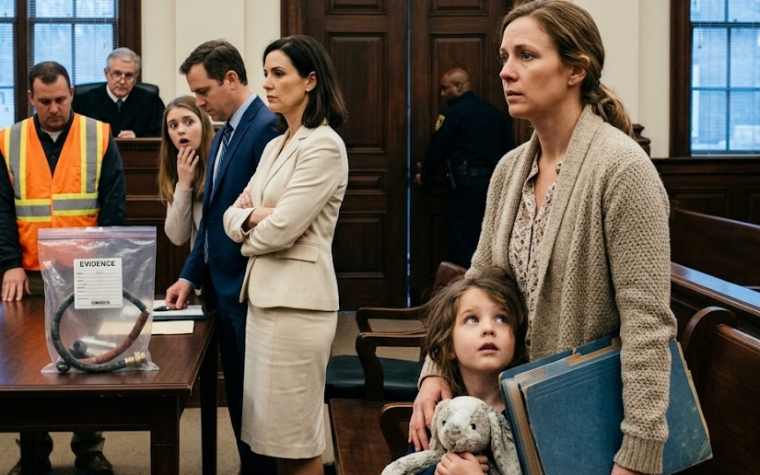
Margaret opened the second folder and placed it beside the first.
Robert stared at the documents on the judge’s bench as though they had appeared by magic.
“They are not valid,” he said.
His lawyer caught his sleeve, but Robert pulled away.
The judge looked over her glasses.
“I asked whether that is your signature.”
Robert glanced toward Marla.
She was no longer smiling.
Her fingers remained wrapped around his arm, but the confidence had left her face.
“Yes,” Robert finally said.
“It looks like my signature, but I had no idea what I was signing.”
Margaret’s expression did not change.
“Your Honor, the first folder contains the original ownership instructions for every personal bank and investment account Mr.
Richardson has asked this court to place under his control.
The second contains the acknowledgment letters, the bank confirmations, and the notices delivered to both spouses two years ago.”
Robert leaned toward his attorney.
“Stop this.”
The attorney whispered something sharp, but Robert was no longer listening.
The judge examined the first document again.
“These instructions name Mrs.
Richardson as the sole account holder.”
“Yes, Your Honor,” Margaret said.
“And Mr.
Richardson signed each transfer.”
“He signed every page.
He also initialed the ownership summary.”
Robert stood so quickly that his chair scraped across the floor.
“She tricked me.”
The judge’s gaze hardened.
“Sit down.”
Robert remained standing for half a second too long.
Then he lowered himself into the chair.
I watched the veins move in his neck.
Two years earlier, I had not known about Marla.
I had known only that Robert had stopped seeing me as a partner.
My first surgery had frightened me more than I admitted.
While I recovered, medical bills arrived in white envelopes and disappeared beneath business magazines on Robert’s desk.
He never opened them.
He told me his work was too important for household details.
One afternoon, I asked him where our account records were kept.
He laughed.
“Why would you need those?”
That question stayed with me.
For decades, I had balanced household ledgers, prepared client dinners, reviewed contracts Robert was too impatient to read, and signed personal guarantees when Richardson Holdings had little more than a rented office and a telephone.
Yet when I became ill, Robert behaved as though I had become a dependent guest in my own life.
I called Margaret.
She had handled our estate documents for years.
Robert disliked her because she remembered every promise he made and kept copies of everything he signed.
Margaret did not tell me to panic.
She told me to gather facts.
We reviewed every personal account Robert called his.
Some had begun as joint savings.
Others held profits we had accumulated during the marriage.
One contained money from property I had sold years earlier.
Robert had treated all of it as a single private reservoir available whenever he wanted a new car, a business acquisition, or a weekend he did not intend to explain.
I did not empty the accounts.