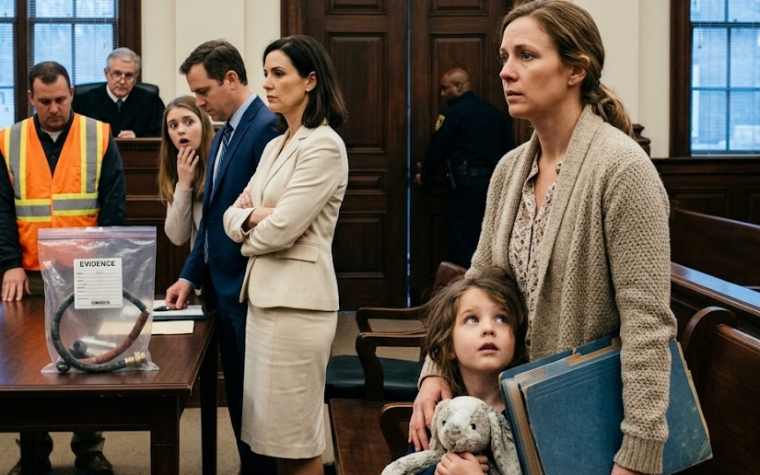
Caleb’s finger rested beneath a row of numbers written in his careful block letters.
Nathan’s face had already lost its color.
The judge leaned forward.
“Caleb, do you understand why you’re here?”
My son nodded once.
Nathan’s lawyer rose immediately.
“Your Honor, this child has not been called as a witness, and given his documented difficulties—”
“Sit down,” the judge said.
The lawyer sat.
Caleb looked at the copy of the divorce agreement on the evidence table.
Then he looked at the financial attachment beside it.
His voice was quiet, but every person in the courtroom heard him.
“Those aren’t Mom’s sevens.
Dad wrote them, because Mom always crosses hers.”
For one suspended second, nobody moved.
Then the judge picked up the two pages.
Nathan recovered quickly.
He had built his reputation on recovering quickly.
“This is absurd,” he said.
“He’s seven years old.”
The judge examined the handwritten notations beside two transfer schedules.
One page carried my signature.
Beneath it, someone had added an account number and a contract reference in blue ink.
The number seven had no crossbar.
I had crossed every seven I had written since elementary school.
Caleb knew because he watched me write grocery lists, school dates, medication times, phone numbers, and notes inside his lunch box.
To most people, it was a meaningless habit.
To him, it was a pattern.
The judge placed the pages side by side.
My attorney stood.
“Your Honor, we request immediate preservation of the original documents and all electronic records associated with these schedules.
Page twelve identifies Contract 714, but the attached valuation refers to Contract 414.
The handwritten correction appears after Mrs.
Whitaker’s signature.”
Nathan’s lawyer rose again.
“A clerical inconsistency in a private settlement does not justify—”
“It isn’t private,” my attorney said.
“Both numbers appear in Whitaker Global reserve transfers.”
A murmur passed through the courtroom.
Nathan turned toward me.
Until that moment, he had believed I came to fight over a house, a trust, and a humiliating custody argument.
He had believed the offer was large enough to make me grateful and the threats were sharp enough to make me silent.
He had not considered that I might read the documents.
He had considered even less that Caleb would.
The judge asked for the black notebook.
Caleb held it tighter.
I touched his shoulder.
“It’s all right.”
He released it.
The first pages contained things any child might record: the number of blue cars on our street, the times the garden sprinklers started, the dates Nathan missed dinner, and how many minutes Vanessa stayed during visits Nathan claimed were business meetings.
Then the entries changed.
Three months earlier, Caleb had wandered downstairs after waking from a nightmare.
He had stopped outside Nathan’s home office when he heard voices.
He did not understand corporate reserves, shell entities, or marital trusts.
He understood repetition.
Nathan had read strings of numbers aloud while Vanessa repeated them into a phone.