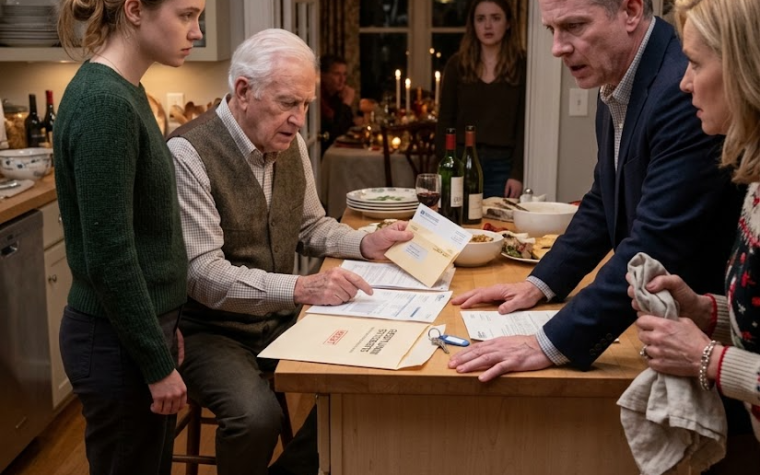
Beneath it were the trust documents Richard had glimpsed.
For most of her adult life, those papers had represented money she deliberately chose not to make central to her identity.
During the divorce, they had become something else: proof that Richard’s contempt had never been about facts.
He had not called her worthless because she was poor.
He had called her worthless because he believed she needed him.
That realization freed her more completely than the settlement ever could.
In the weeks that followed, Richard’s attorney sent formal inquiries about the agreement and Henry’s disclosures.
Her counsel answered each one with records, dates, and signatures.
No dramatic courtroom battle followed.
There was simply paperwork confirming what had already happened.
The divorce became final.
Richard kept Sterling Dynamics.
Henry kept the assets that had always legally been hers.
Daniel’s investment group did not suddenly punish Richard or destroy his company.
Henry refused to use her family’s influence that way, and Daniel agreed.
Sterling Dynamics would succeed or fail on its own merits.
That consequence frustrated Richard more than revenge might have.
There was nobody to blame for every rejected proposal, every business decision, or every relationship he had damaged.
Jessica remained in his life for a time, though friends quietly reported that the story Richard told about the divorce changed depending on his audience.
In one version Henry had deceived him.
In another she had manipulated the settlement.
In another he claimed he had always known she came from money and simply had not cared.
Henry stopped correcting him.
She no longer needed control over the version of herself that existed in Richard’s mouth.
Months later, she returned to the house one final time to collect a box left in storage.
The rooms were nearly empty.
In the study she found an old photograph tucked behind a drawer: Richard and Henry sitting on the floor of their first apartment, surrounded by takeout cartons and handwritten business plans.
Richard was laughing at something outside the frame.
Henry was looking at him as though she believed they were building one life together.
She sat on the floor for a moment with the photograph in her hand.
Then she cried.
Not because she wanted him back.
Because that younger woman had deserved better than the ending she received.
Henry slipped the photograph into her box and stood.
Outside, no Rolls-Royce waited dramatically at the curb that day.
Daniel was not there.
There were no mediators, lawyers, witnesses, or stunned faces.
Henry drove herself home.
That mattered more.
Richard had spent years believing power was the ability to make people need you.
Henry had learned the opposite.
Power was knowing exactly what you could claim—and choosing what was worth carrying away.
She had left him the company, the house, the furniture, the cuff links, and every story he needed to tell himself.
She kept her name.
She kept her dignity.
And when she closed the door behind her, there was nobody left in the room whose opinion could change what either one was worth.