Eleanor’s office remained empty for several weeks.
I could not bring myself to use it.
One evening, I finally sat behind her desk and opened the personal letter she had left for me.
Most of it concerned the company, but the final paragraph was written in her own uneven hand.
“You once protected my life’s work when betraying me would have solved your immediate problems.
I cannot return the years you spent being diminished.
I can only place something valuable in your hands and trust you not to diminish yourself again.”
I cried then.
Not in the courtroom.
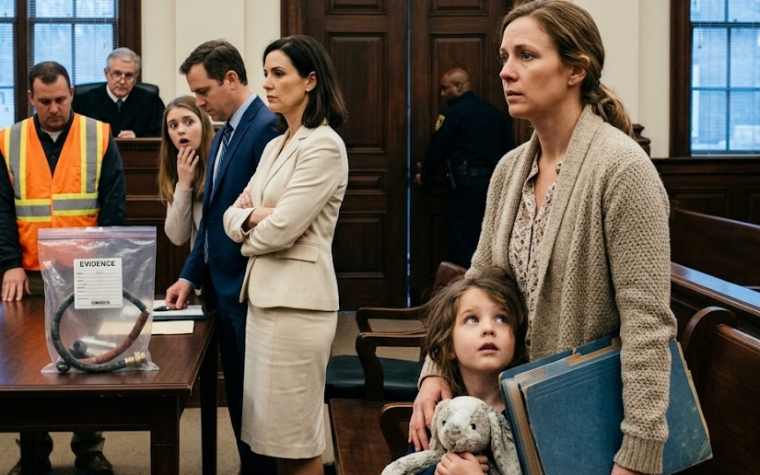
Not while my husband’s attorney reduced my marriage to columns on a financial schedule.
Not when the judge exposed the transfers or when strangers watched my husband call our child cruel names.
I cried alone in Eleanor’s office because someone had remembered me accurately.
My daughter found me there after school a week later.
She walked around the desk, climbed into the chair beside mine, and examined the photographs on the shelf.
“Was Ms.
Whitaker your boss?” she asked.
“She was.”
“And now you have her job?”
“Part of it.
I still have to earn the rest every day.”
She considered that seriously.
“Did she know Dad was wrong about you?”
I looked through the glass wall at the employees gathering for an evening meeting, waiting for me to lead it.
“She knew who I was before he started telling that story.”
My daughter leaned against my shoulder.
“I knew too,” she said.
The divorce became final shortly afterward.
Outside the courthouse, my former husband walked past without speaking.
There was no apology, no sudden understanding, and no perfect ending in which cruelty turned into remorse.
But he could no longer make his version of me the only version entered into the record.
My daughter and I returned home.
I placed the blue cardigan in a donation box, and she chose a bright green jacket for school the next morning.
Before bed, she asked whether the sealed file had saved us.
I thought about the binder I had built page by page, the work I had performed without recognition, Eleanor’s trust, my attorney’s patience, and the moment my daughter stopped trembling when the truth finally gained a voice.
“The file helped,” I told her.
“But it didn’t create the truth.
It only opened in time for people to see it.”
She nodded and switched off her lamp.
For years, my husband had told me I had nothing without him.
He was wrong in the simplest possible way.
I had experience.
I had evidence.
I had a daughter watching how I stood back up.
I had work waiting for my hands and a name that belonged to me again.
The sealed file did not turn me into someone powerful.
It proved I had been powerful long before he decided to call me small.