Patricia began with letters.
She wrote one to each child, never demanding affection and never pretending she had been part of their past.
Sophia answered first.
Olivia followed because she wanted to know whether Patricia had bought the promised presents.
Noah waited three months.
Ethan waited longer.
Marcus attended counseling before the children agreed to see him again.
Their first meeting took place in Austin, in a quiet room where nobody wore holiday clothes and nobody held a ring box.
He apologized without blaming me, his mother, fear, confusion, or youth.
Noah asked the question that mattered most.
“Why didn’t you believe Mama?”
Marcus looked at me, then back at his son.
“Because believing her meant I had to be responsible,” he said.
“I was scared, and I chose to call her a liar instead of admitting I was a coward.”
The answer did not heal eight years.
But it was the first honest thing he gave them.
Our children did not run into his arms.
There was no miraculous reunion.
Trust arrived in inches: a returned phone call, a birthday remembered without prompting, a school event attended quietly, an apology repeated through action rather than words.
Sometimes Marcus succeeded.
Sometimes he disappointed them.
When he did, I refused to soften the consequences for him or let his failures become evidence that my children were unworthy of love.
Ashley never returned.
Patricia told me later that Marcus’s polished social world changed after Christmas.
Relatives who had laughed at his stories about his “unstable ex-wife” stopped laughing.
Friends asked questions.
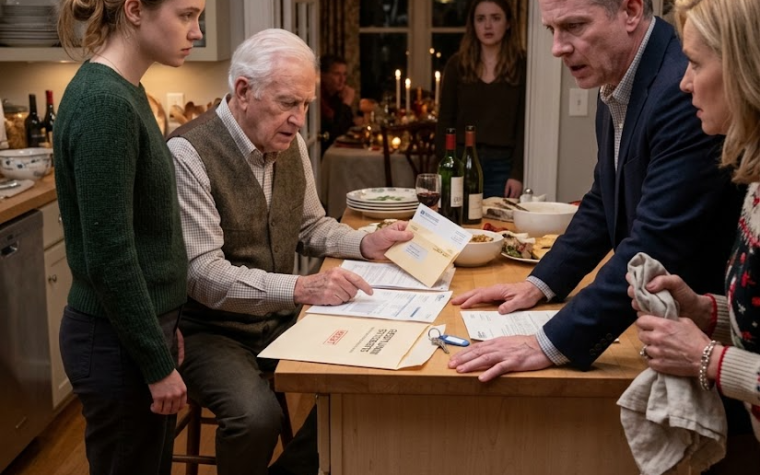
The version of himself he had maintained for years could not survive the evidence sitting inside that folder.
I had not gone to Boulder to destroy his life.
I went because he had summoned the woman he thought was still ashamed, and I was finished allowing his lie to occupy space in my children’s future.
The following Christmas, Patricia came to Austin.
She arrived without demands and carried four carefully chosen gifts.
Marcus came separately because boundaries still mattered.
After dinner, Noah found the old hospital photograph in the folder and placed it beside a new picture of the quadruplets laughing around the tree.
In the first image, I looked exhausted and frightened, holding four babies whose future I could not imagine.
In the second, I stood behind four strong children who knew exactly who had stayed.
Marcus looked at both photographs for a long time.
“I missed everything,” he said.
I did not comfort him.
“Yes,” I replied.
“You did.”
Outside, the children called for me to see the snow beginning to fall.
I closed the folder and went to them.
For eight years, Marcus had believed abandoning us was the final word in our story.
It was not.
The final word belonged to the life we built after he left—a life full enough to survive his absence, strong enough to face his return, and honest enough that none of us ever had to carry his shame again.