I did not cry for Graham.
I cried because my grandmother had anticipated the shame I might feel and reached across the years to remove it.
The phrase on the envelope had never promised the ring to another man.
It had promised me the right to recognize the difference between a legal husband and a loving one.
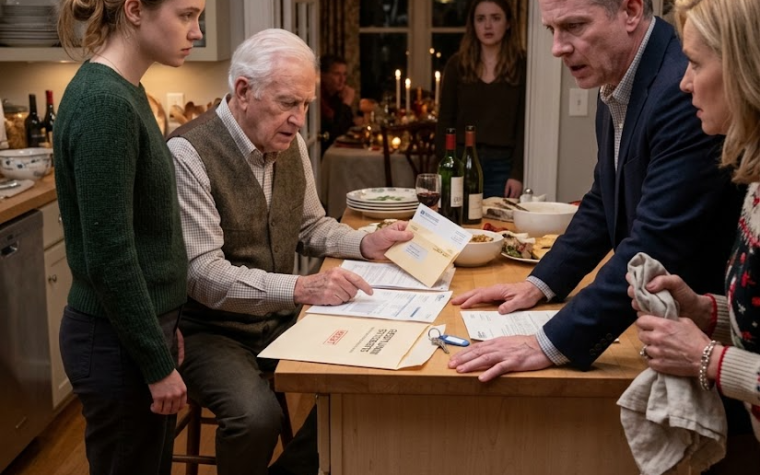
Marjorie turned away before I finished reading.
Her name remained on the codicil beneath my grandmother’s signature, proof that she had once been trusted with the very protection she later helped her son evade.
The consequences did not arrive all at once.
Real consequences rarely do.
The bank suspended the Monday transfer and froze every pending draw connected to Graham’s company.
An independent review found that he had misrepresented several expenditures and used marital assets to support Sloane without my consent.
Caldwell Urban Development was forced to sell two unfinished properties to satisfy creditors.
Graham’s partners removed him from management before the end of the month.
The district attorney pursued the ring theft and the forged financial documents discovered during the review.
Graham eventually accepted an agreement requiring restitution, financial monitoring, and a formal admission that he had removed property he knew belonged solely to me.
He avoided prison.
He did not avoid the record.
Sloane returned the remaining gifts purchased with diverted funds and cooperated with investigators.
I never became her friend, and I never needed to.
Her honesty arrived late, after damage had been done, but it prevented Graham from rewriting the story around himself.
Marjorie resigned from two charitable boards after her messages became part of the civil proceedings.
She told mutual acquaintances that I had destroyed the family over a piece of jewelry.
People who had been inside the chapel knew better.
The ring was never the entire betrayal.
It was simply the object Graham held up because he believed he could humiliate me without consequence.
My divorce was finalized eleven months later.
Graham tried to argue that the family home reflected his contributions.
The records showed those contributions had largely come from loans connected to my separate trust.
We reached a settlement only after Julian placed the safe footage, bank transfers, and church statements on the conference table.
This time, Graham did not tell me I was under stress.
He signed.
On the first Sunday after the divorce became final, I returned to Grace Harbor Chapel.
The third pew was empty.
Sunlight passed through my grandmother’s angel and spread pale colors over the floor.
Pastor Whitcomb met me near the communion rail.
He apologized for not seeing what had been happening sooner.
“You saw it when it mattered,” I said.
Officer Ramirez had returned the ring after the case concluded.
I carried it that morning in its original velvet box.
Pastor Whitcomb asked whether I wanted him to bless it.
“Not yet,” I said.
I opened the box and studied the old diamond, the platinum worn smooth by the hands of women who had survived lives no photograph could fully explain.
Then I turned the ring over.
The tiny emerald remained beneath the crown.
A secret heartbeat.
For years, I thought inheriting the ring meant I had been entrusted with a perfect love story.
I understood now that I had inherited something more useful.
A warning.
A safeguard.
Permission to leave when love became theft.
I closed the box and placed it inside my handbag.
Someday I might wear it.
Someday I might give it to someone who understood what it meant.
Or I might keep it exactly where my grandmother said I could: with myself.
As I walked beneath the stained-glass angel, the chapel doors opened ahead of me.
For the first time in seven years, no one was waiting on the other side to claim what belonged to me.
I stepped into the sunlight carrying my name, my dignity, and my grandmother’s ring.