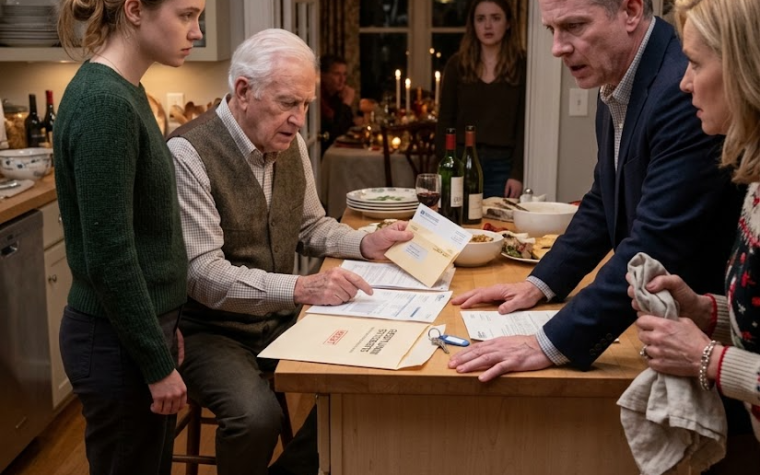
“This institution has treated thousands of people who could not afford care.
Anyone suggesting otherwise is lying.”
Maya shook her head.
“No one said the hospital never helped anyone.”
Richard looked at her.
“That’s how you’re presenting it.”
“No.
That’s how you need me to present it so you can argue with something simpler.”
The room went silent again.
Maya continued.
“I know St.
Catherine’s helps people.
I watch nurses find blankets for children at three in the morning.
I watch residents stay past their shifts.
I watch registration staff spend forty minutes on the phone because a frightened family doesn’t understand a form.”
Daniel lowered his eyes.
“That’s why this matters,” Maya said.
“People are doing real work.
Patients are trusting us.
Donors are giving real money.
If the paperwork says help happened when it didn’t, then everyone doing the honest work gets used as cover.”
Richard had no immediate answer.
Evelyn closed the folder.
The board chair announced that the remainder of the gala program would be shortened.
Independent counsel would meet with relevant officers that evening.
The hospital would cooperate with the state review and contact affected patients if discrepancies were confirmed.
No applause followed.
It was not that kind of moment.
People simply began standing, speaking in low voices, checking on colleagues and moving away from Richard’s table.
The shift in power was almost painfully ordinary.
Nobody dragged Richard away.
Nobody cheered.
His name remained on the surgical wing.
His decades of medical work did not disappear because one envelope had been opened.
But the automatic deference surrounding him cracked.
And once cracked, it could no longer pretend to be the same thing as trust.
Over the next several weeks, an outside review examined the charity-care process.
Multiple administrative failures were confirmed.
Some assistance had been accurately granted.
Other cases had been reported before required steps were completed, and several approval records could not be properly supported.
Controls around donor-restricted funds were tightened, affected accounts were reexamined, and families whose aid had been delayed or incorrectly recorded were contacted.
The state inquiry continued beyond the gala.
Richard was removed from oversight of the charity program while the board determined responsibility for the reporting failures.
He remained a surgeon during the review but lost the committee authority that had allowed his office to pressure administrators over numbers and deadlines.
Mr.
Kline recommended outside counsel for the investigation, partly because his own office had failed to recognize the seriousness of Maya’s earlier internal concerns.
Evelyn insisted that the hospital establish a reporting channel night-shift employees could use without sending complaints back through the same managers involved in disputed processes.
And Maya went back to work.
That surprised people most.
She did not become an executive the next morning.
She did not suddenly receive a corner office.
At 11:00 p.m.
the following Monday, she was behind the same ER desk, wearing the same badge, helping a father who had arrived with his daughter and no idea which insurance card was current.
But things were different.
Supervisors knew her name.
Administrators who had once walked past her desk began asking what night staff were seeing.