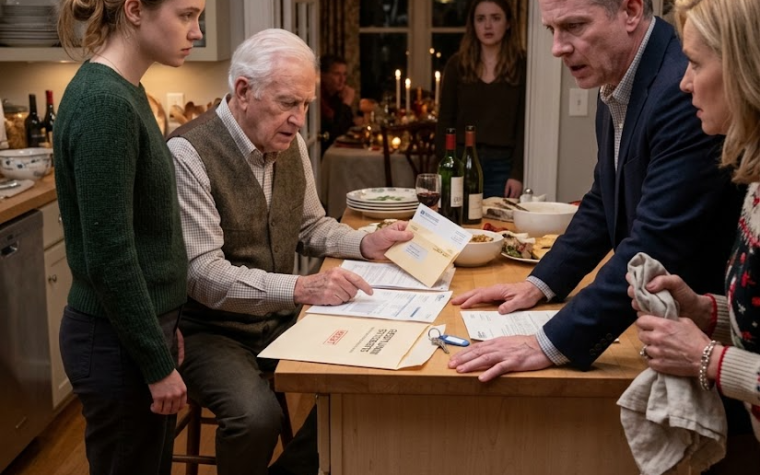
I looked toward the leather folder resting beside my father across the room.
Peter followed my gaze.
He exhaled.
“Right.”
“No,” I said.
“That isn’t the answer I want you to learn.”
He looked back at me.
“I don’t want obedience because I own your debt.
I want respect when I don’t have the folder in my hand.”
Something shifted in his face.
Not attraction this time.
Understanding.
“That,” he said quietly, “may take me longer than one afternoon to prove.”
“You have five years.”
He almost laughed.
For the first time, the number did not sound like a sentence.
The following weeks were not romantic.
They were difficult.
Peter and I met with our lawyers and amended the practical terms of the agreement.
My financial authority remained mine.
Peter’s company received a clear process for requesting consent on matters affecting the Müller debt.
I agreed that I would not use the notes as punishment for personal arguments.
He agreed that my position would be recognized formally rather than hidden behind my father.
Most importantly, decisions concerning me required me in the room.
My father apologized without asking me to forgive him immediately.
My mother stopped filtering invitations unless I asked her to.
George never let Peter forget the morning behind the church door.
Whenever Peter became too confident, George only had to say, “Read the schedules.”
I eventually learned that humiliation can be useful when applied in small doses.
Peter learned something else.
I was not quiet because I had nothing to say.
Sometimes I was quiet because I was listening.
Sometimes because I was deciding.
And sometimes because silence made arrogant people reveal far more than questions ever could.
Months after the wedding, Peter and I returned to St.
Monica’s for a charity concert.
We passed the side door where I had heard him laughing about our marriage.
Peter stopped.
“I still think about that morning,” he said.
“So do I.”
“You could have left.”
“Yes.”
“You could have destroyed me afterward.”
I looked at him.
“I could have damaged your company.”
“That distinction matters to you?”
“It should matter to you too.”
He nodded.
Then he looked toward the chapel.
“Why didn’t you?”
I knew what he meant.
Why hadn’t I called the debt? Why hadn’t I used the leverage the instant I discovered it? Why hadn’t I punished him for every cruel word?
Because Klaus had once convinced me that power meant making another person afraid.
It had taken three years to understand that he was wrong.
“Because having the power to hurt someone isn’t the same as being strong,” I said.
Peter was quiet.