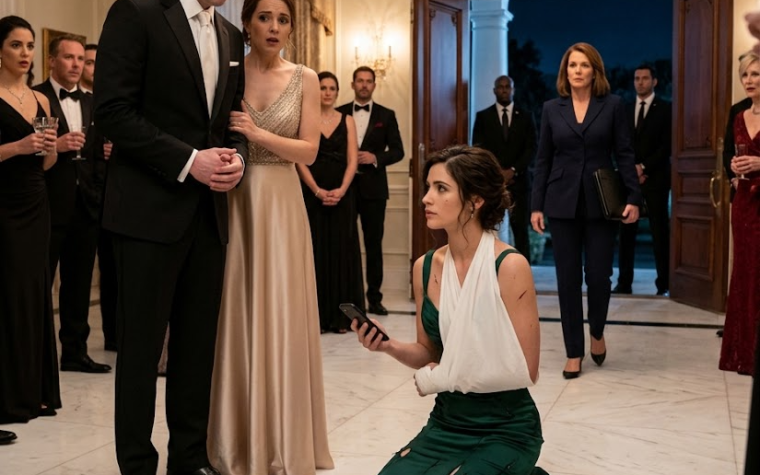
I was bleeding.”
She lowered her eyes.
I did not receive an apology.
People who build their comfort on another person’s labor rarely surrender the story that justified it.
But she left without another insult.
Three months after the accident, I returned to the bakery without crutches.
My first steps were uneven.
The scar down my calf was still red, and a deep ache returned whenever rain pressed against the city.
The staff pretended not to watch as I crossed the kitchen.
On the preparation table sat a crate of strawberries.
The same supplier.
The same bright fruit I had stepped outside to collect on the day everything broke.
I lifted one berry and turned it beneath the light.
For years, Julian had treated my bakery as proof that I was small.
Standing there, I understood that its size had never mattered.
It was the one place where care was freely given, labor was respected, and no one confused service with surrender.
I made the first tart myself.
Chloe leaned against the counter.
“Special occasion?”
“Yes.”
“What are we celebrating?”
I set the strawberry at the center of the glaze.
“Accurate accounting.”
She laughed, and this time I did too.
Later that afternoon, Sophia emailed the finalized divorce judgment.
I read it alone in my office above the bakery.
The marriage was over.
The protected assets remained secure.
The house would be retained by my trust, and Julian had a fixed period to remove his remaining belongings.
The disputed account had been divided according to the settlement, with his attempted transfer preserved in the record.
There was no dramatic final confrontation.
No speech could restore the years I had spent shrinking myself to preserve a home that only felt peaceful when I obeyed.
I closed the email and went downstairs.
Outside, Chicago moved past the windows in winter coats and hurried footsteps.
Inside, the ovens hummed.
A young couple shared a strawberry tart near the door.
Someone dropped a spoon.
Someone else laughed.
My leg hurt, but it held me.
The life around me was not silent, perfect, or painless.
It was mine.
Julian had believed helplessness was the natural condition of a woman who cared for others.
He had mistaken my patience for dependence, my privacy for emptiness, and my love for permission.
The accident exposed the fracture in my leg.
His forty-seven calls exposed the fracture in our marriage.
And the moment I stopped protecting him from the consequences of his own behavior, I did not become cruel, powerful, or dangerous.
I simply became visible again.