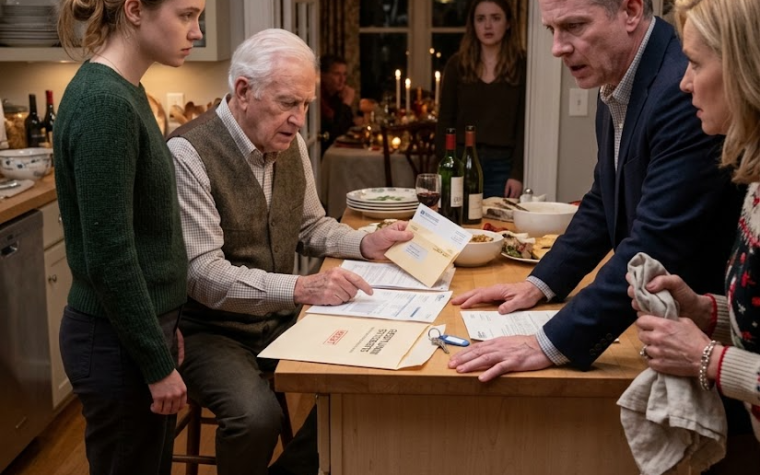
For several minutes, he could not speak.
When he finally looked up, tears had reddened his eyes.
“I missed everything.”
First words.
First steps.
Fevers.
Birthdays.
Four separate personalities forming while he lived less than a day’s drive away.
“You did,” I said.
I did not soften the fact for him.
Ethan nodded.
“I know I can’t get it back.”
“No.”
“But I can stop missing what comes next.”
“That depends on what you do, not what you say.”
He accepted that.
The legal battle Victor threatened never became the weapon he expected.
The agreement governed my contact with Ethan; it did not establish paternity, determine custody, or erase the independent interests of four children who had not existed as parties to it.
My attorney warned that any attempt to use the document against them would expose the circumstances of the payment and Victor’s interference in private communications.
Victor’s lawyers advised him to remain silent.
He did not.
He released a statement calling me an opportunist.
That mistake cost him more than money.
Guests had witnessed his attempt to remove us.
Several had heard him admit that he enforced the separation.
News outlets began asking why one of Seattle’s most powerful men had paid a young woman $120 million to vanish from his son’s life.
Ethan responded with a statement of his own.
He confirmed the paternity results, accepted responsibility for moving too slowly when I disappeared, and asked the public to protect the children’s privacy.
He did not defend Victor.
Within days, he stepped away from his executive role in the Harrison organization and requested an independent review of the family office employees used to block his search for me.
The review found that Victor had ordered staff, lawyers, and private security contractors to redirect correspondence and warn investigators away.
No dramatic handcuffs appeared.
No judge stripped Victor of his fortune overnight.
Real consequences were quieter.
Longtime advisers resigned.
Business partners demanded distance.
Ethan moved out of the family estate.
Claire formally ended the engagement, explaining privately that she could not marry a man while his life was being rebuilt around four children he had just discovered.
Most painfully for Victor, the grandchildren carrying his name knew him only as the angry man who tried to have their mother removed from a wedding.
Ethan began seeing them in supervised visits at a family counselor’s office.
At first, the children called him Ethan.
He brought no extravagant gifts.
I had forbidden them, and he listened.
Instead, he arrived with four library books, remembered which child hated grape juice, learned how to tell the twins’ backpacks apart, and sat through a forty-minute explanation of a cardboard volcano as though it were a corporate presentation.
He made mistakes.
He asked too many questions.
He tried to compensate for lost time by filling every silence.
Once, he promised to attend a school program and arrived ten minutes late after a meeting ran over.
Our eldest daughter refused to speak to him for the rest of the evening.
The next morning, he returned to the school, apologized without excuses, and asked what consequence she thought was fair.
She told him he had to help clean glitter from the classroom floor.
He spent two hours on his knees with tape wrapped around his hand.
That story did more for him than any expensive gesture could have.
Months passed before one of the children accidentally called him Dad.
It happened at a playground when our youngest son fell from a low climbing wall.
Ethan caught him before he hit the ground.