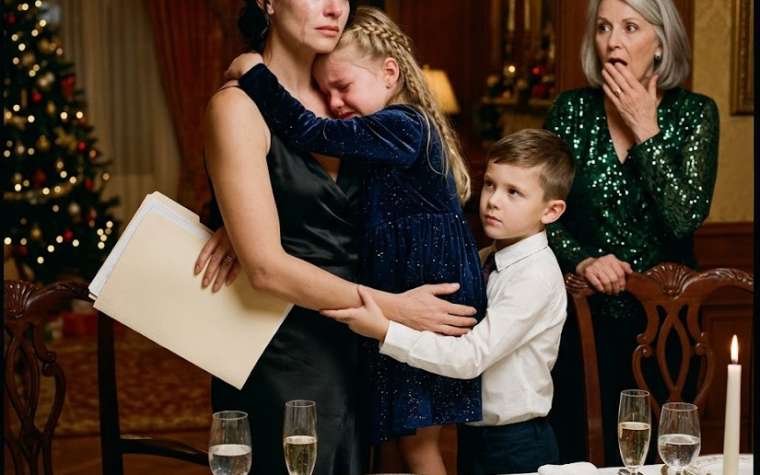
The funeral director testified that Daniel had asked whether the death certificates would be available immediately after the service.
Each detail was small.
Together, they formed the same thing every financial-crime case eventually formed: a structure too consistent to dismiss as coincidence.
The roadside footage came last.
When the vehicle began moving, Daniel lowered his head.
Vanessa covered her mouth.
The prosecutor stopped the video before impact.
No one needed to see more.
The jury deliberated for less than a day.
Daniel was convicted on every major count.
Vanessa was convicted of conspiracy, fraud, and evidence tampering.
Daniel received life in prison without the possibility of parole.
Vanessa received a sentence that ensured she would spend decades behind bars.
The $4 million claim was voided.
The insurer transferred the disputed funds into court control, and the remaining assets connected to the fraud were seized for restitution and legal costs.
When the judge asked whether I wanted to speak at sentencing, I stood with a photograph of the twins in my hand.
Daniel finally looked at me.
He appeared older than he had at the funeral.
Smaller, too.
Without the whiskey, the expensive suit, and Vanessa smiling behind him, he was only a man sitting between two guards.
He expected anger.
I gave him the truth.
“You believed grief would make me weak,” I said.
“You were right that grief changed me.
You were wrong about how.”
I held up the photograph.
“They trusted you.
I trusted you.
You turned that trust into a plan, a policy, and a number.
But they were never worth four million dollars.
They were beyond price, and that is something you will never understand.”
Daniel looked away.
I did not ask him to look back.
Months after sentencing, I returned to the cemetery alone.
I brought two small bunches of white flowers and placed one at each grave.
For a long time, I said nothing.
The world had called the case solved.
The court had called justice complete.
Reporters had moved on to newer tragedies.
But grief did not recognize verdicts.
It still waited in the quiet bedroom at home.
It still appeared when I passed the cereal they liked or found a drawing beneath a stack of mail.
It still woke me some nights with the memory of Daniel’s laugh inside the chapel.
Yet that memory no longer ended with his hand striking my face.
It ended with the doors opening.
It ended with witnesses raising their eyes.
It ended with handcuffs closing around the wrists of the man who believed no one would ever examine his lies.
I touched the top of each headstone.
“I kept looking,” I whispered.
“Just like I promised.”
Then I stood, wiped the dirt from my knees, and walked away without lowering my head.