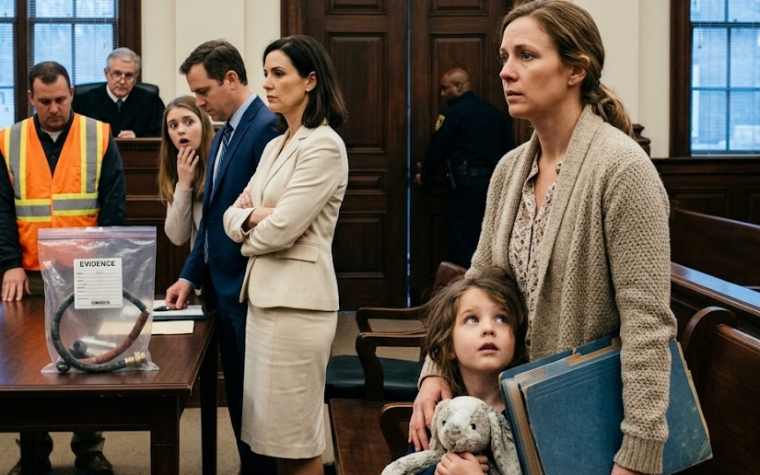
The federal officer said Richard’s full name, and every conversation around his mother’s table seemed to die at once.
Richard straightened as if posture alone could restore control.
His mother’s hand, the one displaying the diamond Rolex beneath the chandelier, slowly dropped toward her lap.
“What is this?” Richard demanded.
The officers did not argue with him.
One asked him to step away from the table.
The other produced paperwork and explained that they were executing a seizure order connected to an investigation into the unauthorized electronic transfer of $28,500 from an account established for Toby’s medical care.
Richard actually laughed.
It was the same laugh he had used whenever I questioned a credit-card bill or asked why another payment had appeared in our joint account.
“That’s marital money,” he said.
“My wife is upset because I bought my mother a birthday present.”
His mother found her voice immediately.
“My son gave me this watch.
You cannot humiliate me like this in front of everyone.”
The officer’s expression did not change.
“Ma’am, we need you to remove the watch.”
Her country club friends stared.
No one reached for champagne now.
She looked at Richard.
For the first time since I had known them, he had no answer ready for her.
What neither of them knew was that the investigation had not begun because I wanted revenge over jewelry.
It had begun because, the morning after Richard emptied Toby’s account, my lawyer told me to stop thinking like a betrayed wife and start documenting facts.
The first fact was simple: I had created the medical account for Toby and funded it almost entirely from my earnings.
Richard knew what it was for.
We had discussed the surgery repeatedly.
He knew the amount we were trying to reach.
He knew the pulmonology practice was scheduled to draw from it.
The second fact was worse.
Richard had not merely transferred money from one ordinary joint checking account to another.
When the bank examined the transaction, its fraud department found that the electronic authorization had been made using my credentials through an account Richard was not authorized to control on his own.
He had moved the funds through an online transfer before paying for the watch, creating a record far clearer than he apparently realized.
He thought marriage meant permission.
The bank did not see it that way.
Neither did my lawyer.
I still remember sitting across from her at the conference table the afternoon we received the transaction history.
She slid the pages toward me.
“Do you recognize this authorization?”
“No.”
“Did you give him permission to make it?”
“No.”
“Did you approve the purchase?”
“No.”
She nodded once.
“Then we preserve everything.”
That became my life for the next several weeks.
Preserve everything.
I saved Richard’s messages.
I downloaded statements.
I copied loan documents.
I gathered the account records showing years of deposits into Toby’s fund.
I kept the bank alert that had awakened me after my fourteen-hour shift.
And I kept Richard’s own words.
She sacrificed everything for me.
You can just work a few extra shifts.
He had said them as if my labor belonged to him.
So I worked.