And, if I was being fair, I had tried to tell Christopher in the beginning.
The first time, he was answering emails while I described the call.
“That’s nice,” he said without looking up.
The second time, I mentioned that I had begun advising a large property group.
He smiled and kissed my forehead.
“Just be careful you’re not getting in over your head.”
The third time, I was preparing a detailed review at our dining table when he glanced at the spreadsheets and said, “I still don’t understand why you spend so much energy on things that aren’t going anywhere.”
After that, I stopped volunteering information.
Not to punish him.
Because repeatedly begging your spouse to take your work seriously is its own kind of humiliation.
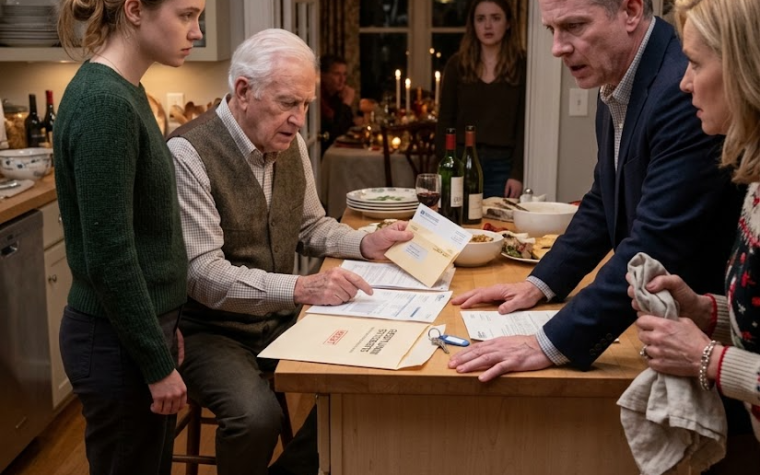
James motioned us toward the library, where perhaps a dozen guests had gathered around a low table.
Christopher followed close behind.
I could feel him trying to solve the situation before it became permanent.
“Natalie,” he whispered, “why didn’t you tell me this was Whitmore?”
“I told you I was advising a property group.”
“You never said his name.”
“You never asked.”
His jaw tightened.
“That’s ridiculous.”
“Is it?”
He looked around quickly to make sure nobody was listening.
“You knew how important tonight was to me.”
That sentence told me more than anything else he had said.
Not: I’m proud of you.
Not: I can’t believe you did this.
Not even: Why didn’t you trust me enough to tell me?
His first instinct was that my achievement had somehow inconvenienced him.
James stood at the front of the library and tapped his glass once.
The room settled.
“I had planned to do this after dinner,” he said, “but since Natalie is finally here, there’s no reason to pretend patience is one of my virtues.”
A few people laughed.
Christopher stood beside me, perfectly still.
James continued.
“Fourteen months ago, I received an analysis that changed how we approached one of the most difficult groups of properties we’ve handled in years.
The author identified risks our own people had underestimated and opportunities we had considered impossible to coordinate.”
Christopher glanced at the folder in my hands.
James raised his glass toward me.
“That author was Natalie Bennett.”
Several guests applauded.
I hated being the center of a room, but I smiled and accepted it.
Christopher clapped too.
He was half a beat late.
James described how the work had developed, carefully avoiding confidential numbers.
What mattered was simple: the project had moved forward because the sequencing I proposed gave his team a path that had not existed before.
Then he said the part Christopher had not expected.
“Natalie has never asked for public credit.
In fact, convincing her to let us acknowledge her tonight required more effort than the negotiations.”
The room laughed again.
Christopher did not.
James reached toward the folder.
“The document she’s holding formalizes the next stage of that relationship.”
I saw Christopher’s eyes drop toward it.
He knew enough about James to understand what that sentence meant.
James was not thanking me and sending me home.
He was asking me to stay involved.
Not as someone’s spouse.