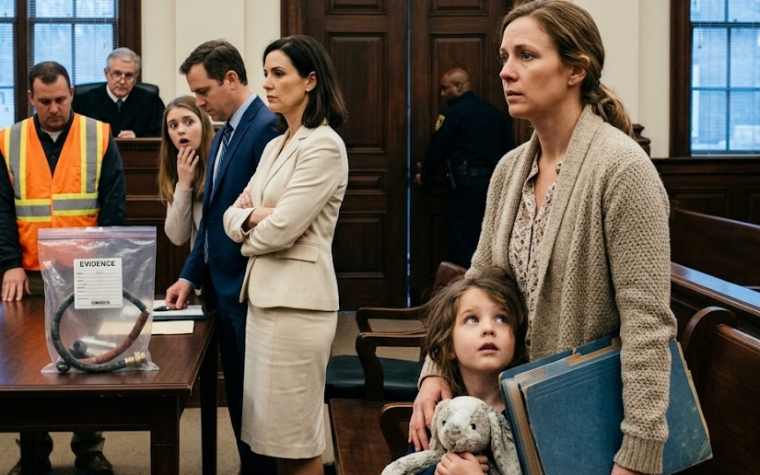
Lydia opened the folder to the payment Wesley had never expected me to see.
She did not raise her voice.
She did not need to.
The paper lay between us on my kitchen table, surrounded by the ordinary remains of a morning that had stopped being ordinary: my good teacup, the silver sugar bowl, the townhouse brochure, and the pearl box I had not put away.
Wesley stood across from me with rain darkening the shoulders of his coat.
Serena remained near the doorway, one hand resting against the front of her cream coat as though the house itself might stain her.
Lydia tapped one line with the end of her pen.
“This payment was listed among Mrs.
Hale’s household support authorizations,” she said.
“But it was not a household expense.”
Wesley looked at me instead of Lydia.
“Mom, this is not what it looks like.”
I had heard that sentence from him before.
When he was nineteen, it had been a dented car.
At thirty-two, it had been a credit card balance.
At forty-six, it had been a mortgage payment he had forgotten to mention until the bank called.
Each time, I had allowed the sentence to become a bridge he could walk across without facing what waited below.
That morning, I let it fall between us.
“What does it look like?” I asked.
His jaw tightened.
Serena stepped forward.
“This is becoming unnecessarily hostile.”
“No,” Lydia said.
“It is becoming clear.”
Wesley turned on her.
“Why are you even here?”
“Because you came to my office demanding that I reverse your mother’s instructions.
You insisted there had been an error.
There was no error.”
He had gone to Lydia less than an hour after the first failed payments.
He had arrived angry, speaking quickly, his phone flashing one rejected charge after another.
He told her I was confused, grieving, impulsive, and perhaps no longer capable of understanding the consequences of financial decisions.
Lydia told him I had understood every document I signed.
Then she showed him the authorization history.
That was when he stopped shouting.
The private business expense had been placed among the automatic payments eight months earlier.
Wesley had described it to me as a temporary household obligation connected to the townhouse.
In truth, it supported a private venture he had never discussed with me.
I remembered the afternoon he brought the form.
He had stood beside my refrigerator while I sliced apples for my granddaughter.
“Just routine paperwork,” he had said.
“It keeps everything organized.”
He had placed a small yellow tab beside the signature line.
I signed because he was my son.
Not because I understood I was funding a business expense.
Not because I had agreed to become the silent foundation beneath every part of his life.
“How much?” I asked Lydia.
Wesley answered before she could.
“It doesn’t matter.
It was being repaid.”
“No,” Lydia said.
“It was not.”
His eyes moved toward the folder.
Serena’s composure cracked first.
“Wesley?”
He rubbed his thumb along the edge of his phone.