Helen’s letter continued.
She said the containers had become a record of our life together.
Not because the food itself mattered.
Because each one marked an evening when somebody knocked on her door without wanting money, a signature, or a favor.
“You thought you were bringing me dinner,” she wrote.
“You were bringing me proof that I had not been completely abandoned by the world.”
Then came the sentence that broke me.
“I should have been your grandmother long before you became my neighbor.
I am sorry that I only learned how at the end.”
I cried then.
Not quietly.
Not gracefully.
Two years of restraint disappeared in that small bedroom.
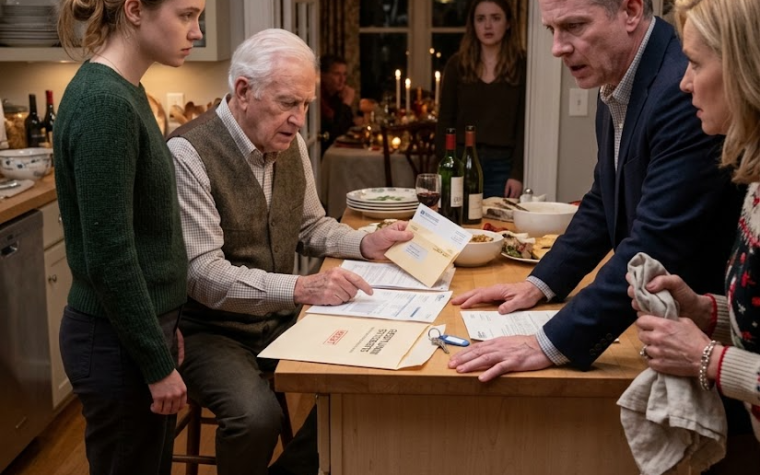
Charlie put a box of tissues beside me and walked out, taking the relatives with him after telling them there would be time to discuss the estate properly through the attorney.
For the first time since I entered apartment 302, I was alone with Helen.
Not her body.
Her life.
I read every letter.
Some were only a page.
Some were four or five.
She wrote about watching for me through the peephole at seven in the evening.
She wrote about pretending not to like sweet pastry as much as she did.
She confessed that she had saved half of one birthday pastry for breakfast and then felt guilty because I had told her to eat it while it was fresh.
She wrote about my mother with tenderness and regret.
She wrote that my mother had once been fierce, funny, and stubborn enough to frighten every Reynolds man in a ten-mile radius.
That made me laugh because it was true.
She never defended my father.
That mattered to me.
She said he had made his choices and that his absence belonged to him, not to me.
The following weeks were messy.
There were phone calls.
Questions.
Accusations from relatives who suddenly had endless energy for Helen’s affairs.
The estate attorney confirmed that Helen had made her decisions deliberately and well before her death.
The family protested, threatened to challenge things, then gradually became quieter as the documents were reviewed.
I didn’t celebrate.
There was nothing satisfying about watching people fight over what an eighty-two-year-old woman had left behind when none of them had been willing to bring her dinner.
I kept only what mattered most to me from the apartment.
Her gray sweater.
The photograph of her beside my mother.
The red ribbon from the letters.
And one plastic container.
The last one.
“Rice pudding.
The last one.”
I almost threw away the label because seeing those words hurt too much.
Instead, I placed the container in my kitchen cabinet.
Months later, I received the final portion of what Helen had left me.
It wasn’t enough to transform my life into something unrecognizable.
It did something better.
It gave me room to breathe.
I paid debts my mother had taught me to fear.
I put money aside.
I replaced the broken chair in my kitchen.
But the inheritance was never the part I thought about at seven in the evening.
At seven, I remembered the sound of Helen’s little footsteps approaching the door.