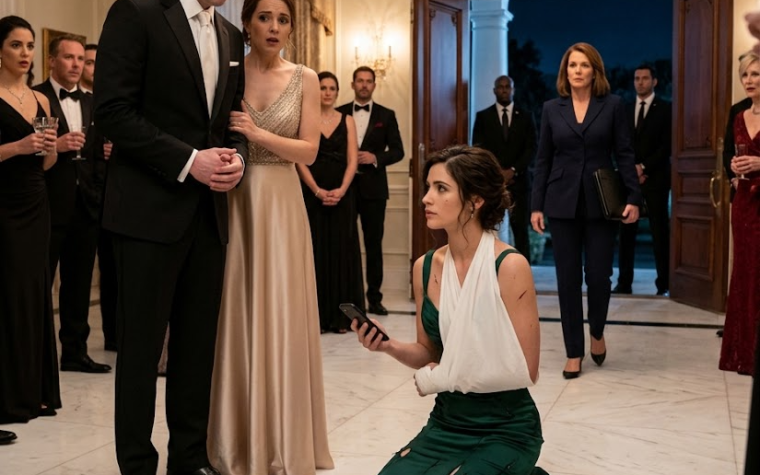
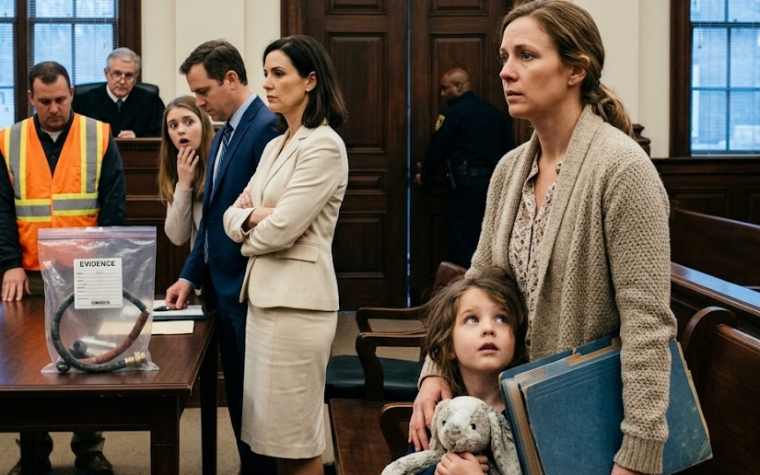
Two ribs were fractured.
The marks around her throat were consistent with strangulation.
Her swollen eye and split lip were documented.
Samples were collected from beneath her fingernails.
Her sweatshirt was sealed as evidence.
Evelyn remained nearby without crowding her.
“The recording is strong,” she explained after Clara was stable.
“But we are not relying on one piece of evidence.
The Garcias will attack the device, the context, your memory, your motives, and your marriage.
We answer with layers.”
Those layers began forming before sunrise.
The emergency recording had automatically uploaded an encrypted copy to Clara’s cloud account.
Metadata confirmed when it began, where the phone was located, and that the file had not been altered.
My photographs documented Clara’s condition less than an hour after the assault.
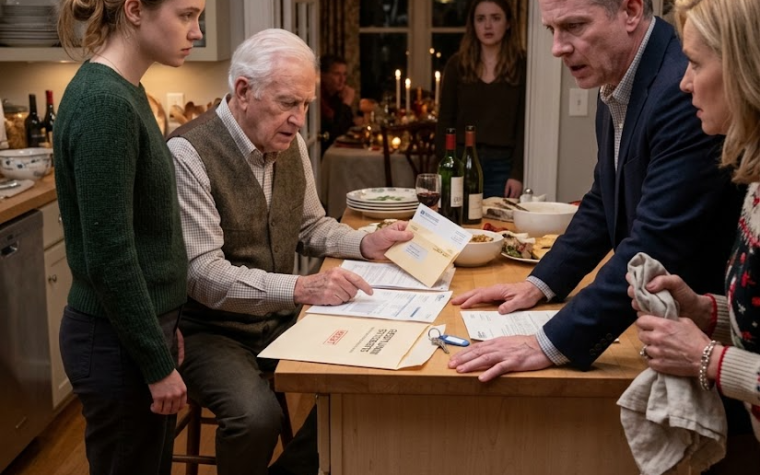
My porch camera recorded William attempting to pressure her into signing an agreement.
The envelope contained a prepared statement declaring that Clara had become emotionally unstable after learning William wanted a divorce.
It claimed she had attacked Tabitha, fallen while being restrained, and voluntarily agreed to enter a private treatment facility.
At the bottom was a broad release surrendering any claim to marital property and authorizing William to make certain medical decisions on her behalf.
The document had been drafted before William arrived at my house.
That meant someone had begun constructing the false story while Clara was still lying injured at the bottom of the stairs.
By eight that morning, a judge had signed orders preserving the Garcia mansion’s security system, household employment records, phone logs, and communications related to Clara’s fall.
Investigators served the orders before anyone could lawfully delete another file.
Tabitha met them in silk pajamas and a neck brace.
She claimed Clara had lunged at her.
William’s mother repeated the same story almost word for word.
The housekeeper, Rosa, initially said she had seen nothing.
Then investigators found a damp cloth in the laundry sink containing diluted blood.
They photographed a freshly scrubbed section of the staircase railing.
They also discovered that one interior camera had been disconnected thirteen minutes after Clara left the property.
The recording system, however, stored backup footage on an off-site server managed by the family’s insurance company.
The Garcias had installed the system to protect their art collection.
They had forgotten it could also protect Clara.
The recovered video did not show the entire staircase, but it showed enough.
Tabitha followed Clara from the dining room, seized her by the throat near the landing, and drove her backward.
William appeared at the top of the stairs seconds later.
He looked down at his injured wife, then turned to his mother and spoke.
The camera had no audio, but Clara’s phone supplied the missing words.
“Stop screaming.
You’re embarrassing me.”
When investigators confronted Rosa with the preserved video and audio, her silence broke.
She admitted that William’s mother had ordered her to wipe the railing and remove a broken bracelet belonging to Clara.
Rosa had hidden the bracelet instead, afraid she would later be blamed.
She retrieved it from a vent behind the laundry dryer.
Several links were missing.
One was still caught in a seam of Tabitha’s sleeve when police photographed her that morning.
Dr.
Mercer became the next weak point.
He denied agreeing to falsify any record.
Then investigators obtained a text from William’s mother sent at 4:02 a.m.: “We need the usual discretion.
Clara had another episode and fell.
Prepare the paperwork.”
Dr.
Mercer had replied, “Bring her through the private entrance.
I’ll handle it.”
He had never examined Clara.
The hospital suspended him pending investigation.