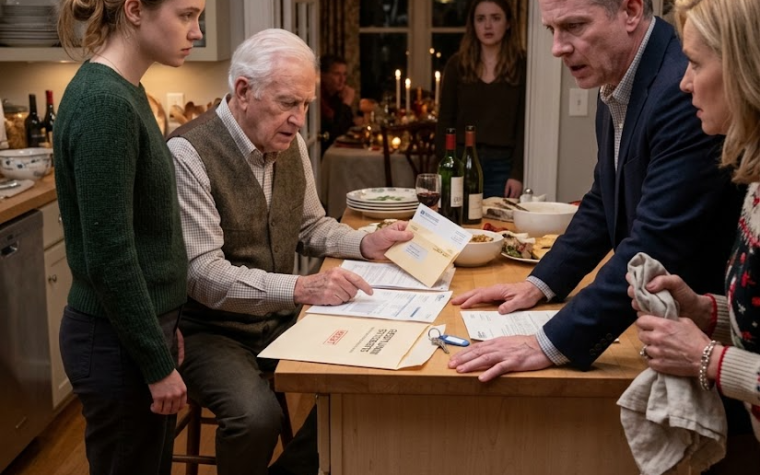
Each was marked as payment for an underground water easement running beneath the eastern pasture.
The agreement allowed Harper County to operate a buried main carrying water from a spring beyond the ridge to the municipal reservoir.
In exchange, the county owed the owner of Parcel 41-B an annual access payment adjusted for inflation.
The checks stopped the year before Wilkes died.
The obligation did not.
The third bundle contained copies of county ledgers.
Beside several payments were handwritten deductions labeled property tax withholding.
The county had taken Wilkes’s taxes directly from the easement money.
Then it had declared those same taxes unpaid.
The farm had been seized and sold at auction for less than two thousand dollars.
Caroline Harper had been the only bidder.
Lily looked toward the road.
Several older people in the parked vehicles had lowered their eyes.
They had known pieces of the story.
Wilkes had spent his final years insisting the county had stolen his land.
People called him bitter.
They laughed when he claimed the proof was locked in a fireproof safe beneath the kitchen floor.
After his farmhouse burned, officials announced that no safe had been found.
Within a month, Amos Wilkes was dead.
The town stopped saying his name.
Lily opened the narrow cash box.
There was no money inside.
There were copies of letters Caroline had sent to the county after purchasing the farm.
She had discovered the buried safe while clearing debris near the chimney.
She had reported its contents and requested an independent review.
The replies all came from the sheriff’s department.
At the time, Wade Mercer had been a deputy assigned to assist with county property disputes.
His first letter called the Wilkes safe a local legend.
His second warned Caroline against possessing county documents.
His third advised her to surrender Parcel 41-B voluntarily to avoid possible prosecution.
Caroline had kept every envelope.
She had also written an affidavit describing what happened after Denise learned about the farm.
Lily read the first paragraph silently.
Seven years earlier, Denise had found a county letter on Caroline’s kitchen table.
She demanded to know why her sister had purchased worthless land with unpaid bills attached to it.
Caroline told her the farm was not worthless.
The county owed its owner decades of easement payments, and the safe proved officials had used false taxes to seize the property.
Denise did not ask whether Wilkes had been wronged.
She asked how much the land was worth.
According to Caroline’s affidavit, Denise returned the following evening with Wade Mercer.
Mercer placed a transfer document on the kitchen table.
“Sign the farm over,” he told Caroline, “and this stays a family problem.”
Denise added, “Lily never has to know.”
Caroline refused.
She moved the original documents back into the safe, buried it beneath the ruins, and concealed the deed inside the book Lily loved most.
Because Lily was still a child, Caroline signed a transfer that would become effective on her eighteenth birthday.
Denise could control Lily’s house, her meals, and her transportation after Caroline died.
She could not legally transfer Lily’s farm before the deed vested.
So Denise waited.
She searched Caroline’s papers for years.
When Lily turned eighteen, Denise changed the locks before breakfast and sent her away with whatever fit inside one trash bag.
She expected Lily to leave town before discovering the deed.
The pearls had not been an accident either.
A notarized inventory inside Caroline’s envelope listed them as Lily’s inheritance.
Denise had allowed Madison to wear them that morning to provoke Lily.
If Lily screamed, threatened them, or tried to tear the earrings away, Mercer would have had a reason to detain her.