I couldn’t prove everything he did.
Afterward, I designed a system no local manager could erase.”
The bitter symmetry settled between us.
Quentin’s first betrayal had created the mechanism that exposed his last one.
The investigation moved quickly.
Access records showed Quentin entering the freezer wing with me and leaving alone.
His employee credential had overridden the door.
The emergency-release handle had been removed with tools found in his case.
The main alarm cable had been cut two days earlier during a period when Quentin was the only manager authorized to enter the control room.
The intercom archive contained his confession, his reference to the insurance policy, and his accidental admission that he had disconnected the alarm.
Financial investigators confirmed more than four hundred thousand dollars in gambling debts.
They also found the life-insurance policy he had purchased months earlier, including the triple-indemnity provision for accidental death.
Quentin tried several explanations.
First, he claimed the recording had been manipulated by Gabriel, whom he described as a vindictive former employer.
Then he claimed I had entered the freezer voluntarily during an argument.
When that failed, he said he had only intended to frighten me long enough to convince me to give him control of an inheritance account.
Each new story contradicted the one before it.
His worst mistake came during a recorded interview when a detective mentioned that the twins had survived.
Quentin leaned back and muttered, “That’s impossible after ten hours.”
The detective had never told him how long I had been trapped.
Only the person monitoring the freezer would have known.
Quentin was charged with multiple serious offenses, including attempted murder, unlawful confinement, insurance fraud, and actions that endangered our unborn children.
He remained in custody while the case proceeded.
From his cell, he sent me three letters.
The first blamed his gambling addiction.
The second blamed Gabriel.
The third blamed me for refusing to help him with his debts.
I opened none of them myself.
My attorney preserved them as evidence.
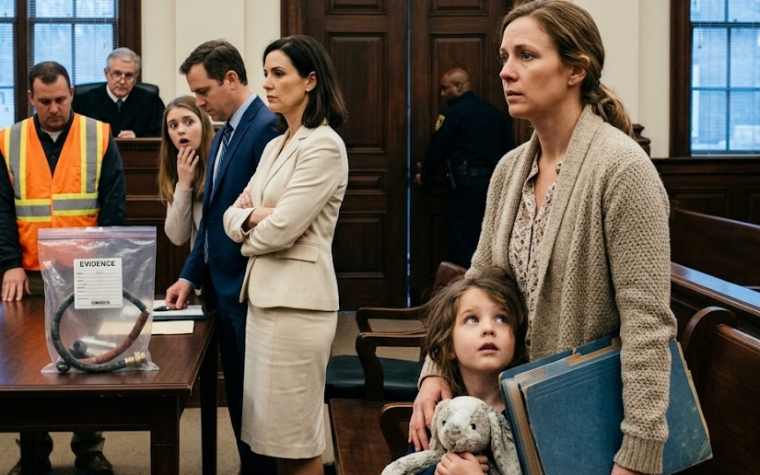
At trial, Quentin wore the same gentle expression he had used during our marriage.
He looked at the jury with wounded eyes and described himself as a desperate husband who had made a terrible mistake.
Then the prosecutor played the freezer recording.
“The insurance policy pays triple for an accidental death.”
The courtroom became perfectly still.
Quentin’s expression changed before the recording even finished.
The softness disappeared.
He turned toward me with the same fury I had seen when the freezer door opened.
The jury saw it too.
Gabriel testified about the independent alarm and the system Quentin had inspired him to create seven years earlier.
Engineers explained the cut cables and removed safety handle.
Financial analysts traced the gambling debts and policy payments.
I testified last.
I described the steel door, the motion-activated lights, the contractions, and the way Quentin calmly told me our children would be better off funded by my death.
His attorney asked why I had trusted Quentin enough to enter the building alone.
I looked across the courtroom at the man I had married.
“Because trust is what marriage is supposed to make safe,” I said.
“He turned it into a weapon.”
Quentin was convicted.
The judge imposed a sentence that ensured he would spend decades in prison.
The insurance policy was voided, his remaining assets were seized through the divorce and restitution process, and the pharmaceutical company terminated every employee who had helped him bypass safety procedures—even unknowingly.
The twins remained in intensive care for several weeks.
I sat between their incubators each day, one hand resting near each tiny body.
Machines breathed and chimed around us.
Nurses taught me how to touch them without overwhelming their fragile nervous systems.
There were setbacks.
One night, a monitor alarm sent me into such a severe panic that I collapsed against the wall.