The signature was mine in shape but not in movement.
Whoever had copied it had reproduced the long first stroke and the small hook at the end of my surname.
They had even copied the slight break where my pen had skipped across the prison marriage license.
But the pressure was wrong.
The letters were too careful.
My real signature leaned forward as if it were always running late.
This one stood perfectly upright.
I looked from the document to Jonah.
“What is this?”
“A proxy agreement.”
“I never signed a proxy agreement.”
“I know.”
Jonah pulled out the chair across from me but did not sit.
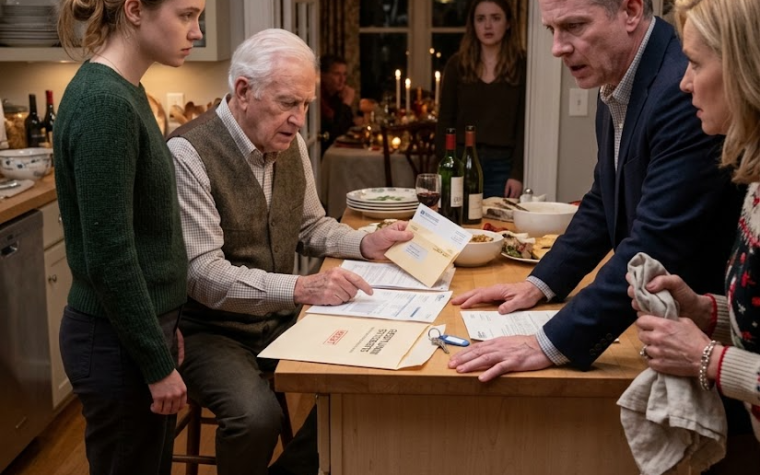
The black box remained open between us, filled with documents separated by yellow tabs.
A small brass key lay on top of a leather-bound booklet bearing the faded seal of his family’s charity.
He had been home for eight days, but in that moment he looked more trapped than he ever had behind prison glass.
“My grandfather created the charity,” he said.
“He also wrote its original trust charter.
Nobody talked about one particular clause because nobody expected it to matter.”
He opened the leather booklet and turned it toward me.
The language was dense, but a paragraph had been marked with a strip of paper.
If a family trustee became incarcerated or legally unable to serve, that trustee’s voting authority would pass temporarily to the trustee’s lawful spouse.
It would remain there until the board formally restored the original trustee.
I read the paragraph twice.
Then a third time.
“I was your trustee?”
“Not exactly.
You held my seat and its emergency powers.”
“What powers?”
Jonah finally sat down.
“The right to demand an independent audit.
The right to block extraordinary transfers.
The right to suspend payments if you believed the charity’s assets were being misused.”
The refrigerator hummed behind me.
Somewhere in the living room, my brother’s television murmured through the wall.
For three years, I had believed I was a paid visitor pretending to give a prisoner dignity.
According to the document in front of me, I had also been the only person with the legal authority to stop the theft that had put Jonah in prison.
“And nobody told me.”
“No.”
“Did your mother know?”
Jonah’s silence answered before he did.
“She knew about the clause,” he said.
“She told herself she was protecting the charity.
My cousin convinced her that the board needed my seat under family control while I was incarcerated.”
I touched the forged proxy.
“So she found someone desperate enough to marry you.”
“Yes.”
“Someone who would sign whatever she put in front of her.”
“That was the plan.”
The words struck harder because Jonah did not soften them.
I remembered every envelope his mother had handed me.
Every receipt.
Every time she had asked me to initial a visitor schedule or confirm that a payment had arrived.
Twice, she had included additional forms and described them as routine family paperwork.
Both times, I had refused to sign because sections were blank.
Her irritation had seemed strange then.