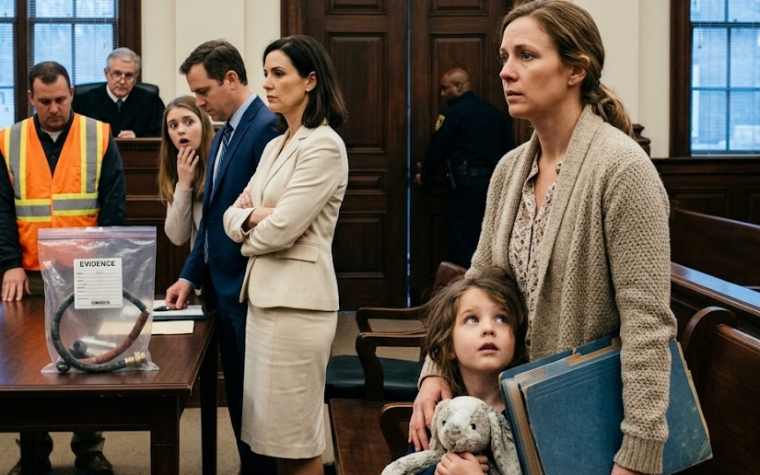
Dad’s fingers stayed on the folder after he opened it, as though letting go might somehow send us all back to the afternoon when none of this had happened yet.
The first page was a printed still from the security camera in our upstairs hallway.
The picture was grainy, taken from high in the corner near the ceiling, but there was no mistaking us.
I was turned away with the dress over my arm.
Natalie stood directly behind me.
Both of her hands were extended against my shoulders.
Beyond us, the glass door was still intact.
The next image had been captured less than a second later.
My body was disappearing through it.
I stared until the shapes stopped looking like people and became shadows.
My throat hurt too much to speak properly, so I looked at Dad.
He understood the question anyway.
“The camera recorded everything,” he said.
Mom made a broken sound beside the window.
I remembered the camera then.
Dad had mounted it months earlier where the upstairs landing gave it a view toward the staircase.
It was small, black, easy to forget.
None of us thought about it because it simply sat there.
Natalie had forgotten too.
Dad turned another page.
There were written notes beneath several still images, but my eyes would not focus long enough to read them.
He did not force me.
Instead he said, “There’s audio.”
That frightened me more than the pictures.
Fragments of the hallway came back in flashes.
The dress.
Natalie demanding it.
My own voice saying no.
Dad starting to tell me to let it go.
Natalie leaning close enough for me to smell her perfume.
You think anyone here is going to choose you?
Then the shove.
Then her voice above me.
Look what you made me do.
I shut my eyes.
Dad stopped turning pages.
“You don’t have to hear it,” he said.
Mom began crying.
I had heard my mother cry before.
Usually over Natalie—an argument, a breakup, a disappointment, some crisis that filled the entire house until the rest of us learned to move quietly around it.
This sounded different.
There was no urgency in it.
Only shame.
I opened my eyes and tried again.
“Where… is she?”
Dad glanced at Mom before answering.
“She isn’t at home.”
That sentence should have been simple.
Instead it seemed to rearrange the room.
Natalie had always been at home, even when she was not physically there.
Her anger lived in the walls.
Her preferences determined dinner.
Her schedule determined when we left.
Her moods decided whether an evening would be peaceful or unbearable.
I could not imagine our house without her influence pressing against every room.
Dad rested the folder on his knees.