“No,” Leah said.
“It is not.”
The security officer asked my father to step away from the entrance.
He did, but only after staring at me as if I had personally damaged his authority by letting other people witness its limits.
Leah spoke quietly to me.
“Would you like law enforcement notified?”
Before I answered, Gavin shoved the ring of keys into his pocket.
“This is insane.
We drove three hours.
The truck is paid for.
We already have bookings.”
The porch went still.
My mother closed her eyes.
My father said, “Gavin.”
But it was too late.
Leah turned toward him.
“Bookings?”
Gavin realized what he had admitted.
He tried to recover.
“Inquiries.
People interested in future weekends.”
“How many?” I asked.
“None of your business.”
“It is my house.”
He laughed, but the sound came out sharp.
“You weren’t using all of it.”
There it was—the belief underneath every demand.
To Gavin, unused space was not mine.
It was merely waiting for him.
My time, money, rooms, and silence all became family resources the moment he wanted them.
Leah asked whether he had advertised the property.
He denied it.
She asked whether he had accepted payments.
He denied that too.
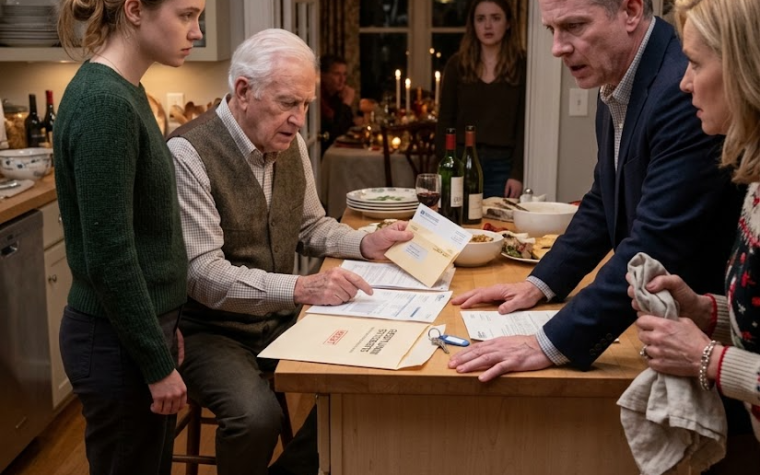
Then the payment processor envelope slipped from the folder in her hand and landed faceup on the kitchen floor behind me.
Gavin saw the company logo through the opening.
His denial stopped.
My father tried a different approach.
“Khloe, nobody is taking your property.
Gavin has been struggling to establish himself.
You left a lucrative job voluntarily.
You bought a house with more rooms than you need.
Your brother saw a way to create income for the family.”
“For the family?” I asked.
“For everyone.”
“Whose name is on the company?”
He did not answer.
Leah did.
“Gavin’s.”
“Whose account receives the payments?”
“We are still determining that,” she said.
Gavin stepped forward.
“You cannot open my mail.”
“We did not,” Leah replied.
“We photographed the exterior and preserved it.
But the company’s public filing lists this property as its principal business address.