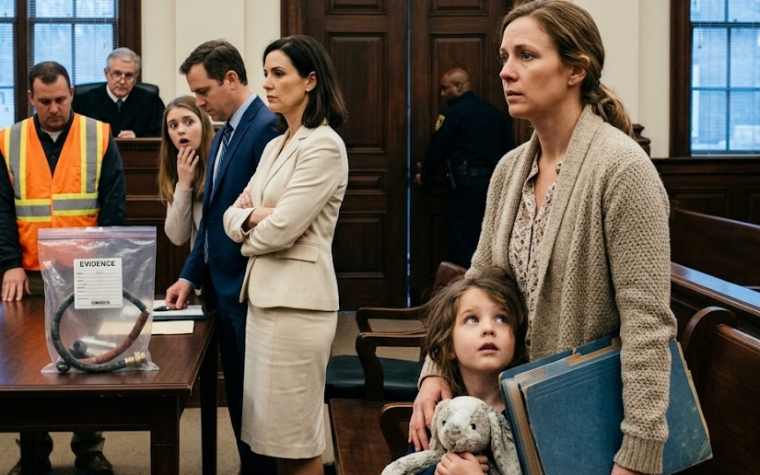
Becca’s voice tightened.
“She said, ‘For when I’m bad.’”
The courtroom became so still that I heard the ventilation system switch on above us.
Marissa’s attorney asked whether Becca had any formal training in diagnosing abuse.
“No,” Becca said.
“So your interpretation is only an opinion.”
“My interpretation is an opinion,” Becca replied.
“The crackers are not.”
He asked why she had not immediately called me.
Becca admitted she had hesitated because Laya had never directly said she was being hurt.
She had begun documenting the child’s statements and had consulted the preschool director.
The afternoon I arrived early, Becca had been preparing to request a meeting with both parents.
“Why did you appear relieved to see Mr.
Morrow?” my attorney asked.
“Because Laya changed when she saw him,” Becca said.
“Her shoulders dropped.
It was the first time that week she looked like she could breathe.”
Marissa shook her head.
“She likes him because he lets her do anything.”
The judge warned her again.
My attorney then introduced the message I had sent Marissa from the parking lot: Picking up Laya early.
Meeting ended fast.
Marissa’s one-word response appeared beneath it.
Okay.
The message alone proved nothing.
My attorney acknowledged that.
Then she placed it beside the camera timestamp.
Marissa had known I was collecting Laya.
She had known our daughter might speak to me without her present.
Yet when I mentioned the statement at home, Marissa did not ask what Laya had eaten, whether she felt sick, or why she might be afraid.
She immediately called her dramatic.
My attorney repeated Marissa’s words from that evening.
“You work so hard.
Sometimes stress makes you overthink.”
Marissa looked at me with naked anger.
“You recorded a private conversation.”
“No,” I said.
“The living-room camera did.”
She had known about that camera too.
Her attorney requested a recess.
The judge denied it until the remaining exhibits were identified.
The final item was not another recording.
It was a simple timeline I had created from the preserved files, preschool notes, pickup records, and my own observations.
I had not diagnosed Marissa.
I had not labeled her.
I had written only what could be verified.
3:17 p.m.: Laya asks for food.
3:18 p.m.: Pantry door is slammed.
3:19 p.m.: Laya is ordered to sit.
5:17 p.m.: Laya remains at table.
5:47 p.m.: Laya is released.
5:48 p.m.: Marissa eats from refrigerator.
The judge read every line.
Marissa’s attorney finally obtained permission to speak privately with her.
They stood near the side wall, whispering.
Marissa kept shaking her head.