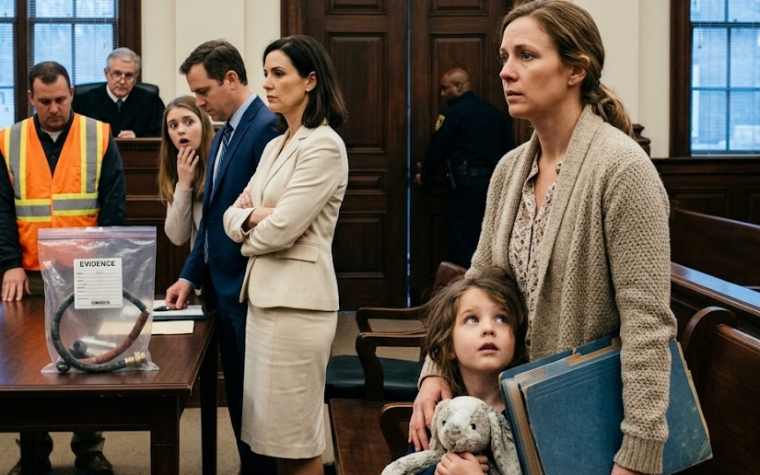
“Why?”
“Because my wife can become emotional.”
There it was again.
The same label.
The same shield.
He had spent so long using my feelings as evidence against me that he no longer seemed aware of how often he relied on the accusation.
My attorney rose when it was our turn.
She did not call Daniel cruel.
She did not accuse him of brainwashing Avery.
She did not give the courtroom the dramatic speech I once imagined I would want someone to make on my behalf.
She did something much more effective.
She compared his sworn claims with the recording.
One by one.
Daniel had described the night I cried as proof that Avery had witnessed frightening emotional instability.
The recording included him reminding Avery about “the night Mom was crying” and repeatedly asking whether it had scared her.
Avery had answered, “I was sad because Mom was sad.”
He asked again.
“Were you scared?”
She finally said, “A little, I guess.”
That phrase—“a little, I guess”—appeared in substance in his custody allegations as Avery expressing fear of my emotional behavior.
The forgotten dinner was similar.
Daniel’s filing made it sound like Avery went without food because I had become incapable of managing the household.
The recording revealed that he knew exactly what happened: we had spent too long finishing her project, realized the hour, laughed about my mistake, and made breakfast for dinner.
He had converted an imperfect family night into an exhibit.
The financial allegation was thinner still.
Daniel’s attorney had suggested my judgment was questionable because I had recently changed household spending and moved some expenses into my own account during our separation.
My attorney produced the timeline showing those changes happened after Daniel sought sole custody and while we were separating finances on legal advice.
Nothing mysterious.
Nothing reckless.
Just a marriage ending badly.
What made the recording devastating was not that Daniel had invented every event.
He hadn’t.
That would have been easier to expose.
He had taken real moments, stripped away their context, taught Avery which details mattered, and presented the result as objective concern.
That was why his story had sounded convincing.
It contained facts.
Just not the whole truth.
Daniel was given another opportunity to explain himself.
This time his calm performance disappeared completely.
“So now I’m the villain because I talked to my own daughter?”
The judge’s expression hardened.
“No one has used that word.”
“My wife used to investigate people for a living.
She sees schemes everywhere.”
I almost laughed at the irony, but I didn’t.
He pointed toward me.
“She knows how to make everything look suspicious.”
My attorney stood.
“Your Honor—”
The judge raised a hand.
Daniel kept going.
“And apparently now Avery is recording people in their own homes.
Where do you think she learned that?”
Avery flinched.
The entire courtroom saw it.
Daniel saw it too.