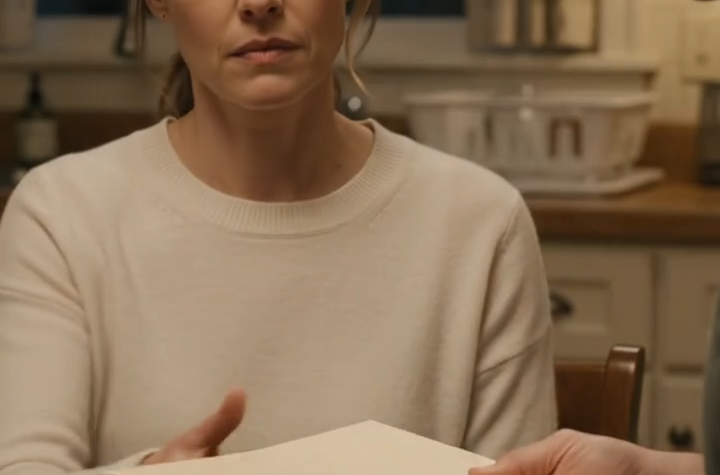
When he unfolded it, I forgot how to breathe.
Mark stood outside a roadside motel with one arm around the woman now sitting in my living room.
He wore sunglasses and a baseball cap, but I knew the angle of his jaw, the scar beside his left ear, and the watch I had given him for our tenth anniversary.
A printed date appeared along the border.
The photograph had been taken seven months after his funeral.
The woman saw it and began to cry.
Not quietly.
Not with grief.
With panic.
“He told me he destroyed that,” she said.
The room went still.
One officer asked, “Destroyed what?”
She pressed both hands over her mouth.
That sentence became the first crack in everything Mark had built.
The police took her to the station for questioning.
I spent the afternoon giving a statement beneath fluorescent lights while my house was searched with my permission.
At first, they found nothing beyond the keys, the photograph, and the contents of her handbag.
Then Mrs.
Gable brought them the recordings from her porch camera.
The first showed the woman arriving at 11:43 on Monday.
She wore a tan coat and carried the same red handbag.
She unlocked my front door, stayed forty-seven minutes, and left.
Tuesday, she arrived again.
Wednesday, again.
Each time, the screaming began several minutes after she entered.
Mrs.
Gable had captured the sound on her phone.
It was a woman’s voice pleading, “Please stop,” followed by a crash and several seconds of sobbing.
The exact same sequence repeated on two separate days.
Same words.
Same crash.
Same breath between the sobs.
A recording.
The officers returned to my house and searched more carefully.
Behind folded towels in the hallway linen closet, they found a small wireless speaker connected to a portable battery.
It had been placed near an air vent, allowing the sound to travel through the walls and out toward Mrs.
Gable’s property.
The audio files were stored on the woman’s phone.
There were six of them.
There were also messages from a number saved under a false name.
The messages never used Mark’s name, but I recognized his rhythm immediately: the clipped sentences, the lack of greetings, the assumption that instructions would be obeyed.
Play the second track at noon.
Move something small.
Use the blue mug.
If the neighbor complains, she’ll start questioning herself.
Find the gray envelope before Laura moves anything.
The most recent message had arrived that morning.
Patio door opened after she left.
She may have come back.
Be careful.
Mark still had access to our old home-security account.
I had stopped using the system after his death, but the door sensors remained connected to the internet.
He had been watching every time I left, returned, or opened the patio door.
That was how the woman knew I had not gone to work.
It was also why Mark sounded so calm when he asked whether I suspected anything.
For two years, he had watched my routine from a phone while I mourned him beneath the same roof.