Hazel swallowed.
“You started crying.”
“I didn’t know you saw that.”
“You never knew how much we saw,” Iris replied.
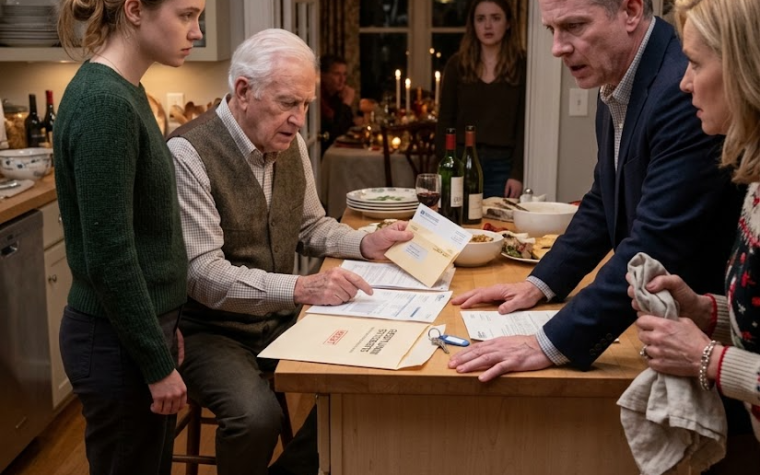
She opened the envelope and spread its contents across the table.
There were deposit slips, faded receipts, printed emails, and photographs of small painted cards.
Some pages were old enough to have been written in a child’s uneven handwriting.
Others showed careful columns of numbers.
At the top of the oldest page, Hazel had written three words in purple pencil.
Dad’s Watch Fund.
The letters tilted in different directions.
I looked up at them.
“You were eight.”
“We started with birthday money,” Hazel said.
“And the coins from the jar in our room,” Iris added.
I remembered that jar.
It had once been filled with loose change from my pockets.
Every few weeks, the coins would disappear.
I assumed the girls had bought snacks at school or small gifts for each other.
They had been saving every cent.
At ten, they began making greeting cards during long afternoons between therapy appointments.
Their art teacher helped them sell the cards at a school fair.
They told me the money had gone toward new paint supplies.
It had gone into the watch fund.
At twelve, Hazel began painting small watercolor portraits of pets.
Iris handled messages and kept track of payments.
At fourteen, they started taking digital illustration requests online under a name I had never seen.
They worked after homework, after therapy, and sometimes after they believed I had gone to bed.
The floorboards I heard creaking at night had not been my imagination.
They had been moving between their rooms, exchanging sketches, receipts, and plans.
I looked at the stack of evidence covering the table.
“You hid all of this from me?”
Hazel managed a nervous smile.
“You would have stopped us.”
She was right.
I would have told them to keep every dollar.
I would have insisted they spend it on college, equipment, clothes, or anything that made their lives easier.
I would never have allowed them to sacrifice for an object I had chosen to sell.
“That money belongs to you,” I said.
“Your future—”
“Our future is safe,” Iris interrupted.
She slid another page toward me.
It showed two separate savings accounts containing their scholarship money and earnings from recent work.
The watch fund had been kept apart from everything else.
They had planned carefully.
Almost frighteningly carefully.
Hazel pointed to the oldest pawn receipt on the table.
“We found this in the tax folder when we were eleven.”
The receipt carried the pawnshop’s name, the date of the sale, and the watch’s serial number.
The girls had copied the number into a notebook and called the shop when they were thirteen.
The original owner had retired by then.
A younger man had taken over the business.
He searched the records and told them the watch had been sold years earlier to a private collector.
He refused to give them the buyer’s name.
“So we wrote letters,” Iris said.
“For five years?” I asked.