Do not let that stop you.”
At 5:03, he had added, “Once the lock is open, leave immediately.
This is a medical emergency.”
There had been no medical emergency.
There had been a banking deadline.
Eleanor eventually hired her own lawyer.
Faced with account records bearing her signature, she stopped protecting Anthony.
She admitted he had instructed her to sign company forms and had described the payments as money Marissa would never miss.
She claimed she believed the arrangement was lawful.
The messages on her phone suggested otherwise.
After one large transfer, she had written to Anthony, “Are you certain she cannot see this?”
He had replied, “She only sees what I allow her to see.”
That sentence hurt more than the total on any statement.
It explained our marriage with brutal precision.
He had never mistaken my trust for permission.
He had treated it as concealment.
The civil court froze the shell company’s accounts and the luxury assets purchased with its funds.
The auction house voided Eleanor’s necklace transaction before the piece changed hands.
Several other items were surrendered while attorneys traced the money used to acquire them.
The bank’s investigation confirmed that the credit facility had been created through forged approvals.
My holding company was not held responsible for the unauthorized balance, and the board’s insurers pursued additional recovery.
The criminal case moved more slowly, but the evidence did not weaken.
Anthony faced charges connected to the forged documents, stolen funds, attempted transfer, and unlawful entry into my home.
The exact counts changed as investigators assembled the transactions, but the core story remained the same: he had used my identity, my company, and my trust to finance a hidden system benefiting himself and his mother.
Months later, he accepted a plea rather than allow the full archive of messages to be read at trial.
He admitted creating false authorizations and attempting to obtain the security key from my penthouse.
The agreement included restitution, forfeiture of assets tied to the scheme, and a custodial sentence.
Eleanor avoided the same outcome only by cooperating, surrendering assets, and admitting her role in the shell company.
Her social circle learned why the Cartier payment had failed—not because a vindictive former daughter-in-law had embarrassed her, but because the card was connected to stolen money.
The humiliation she had feared at the auction became insignificant compared with the truth.
My divorce attorney reopened the financial settlement after the concealed account was discovered.
Anthony had signed sworn disclosures claiming no such funds existed.
The money he tried to hide became evidence against him, and the remaining civil claims ended with a judgment that stripped away the advantage he thought secrecy had secured.
The board did not remove me.
That had been one of Anthony’s favorite threats: that powerful people would lose confidence in me if they saw conflict in my personal life.
Instead, the partners had watched me stay calm during an active break-in, preserve evidence, protect company funds, and refuse to be manipulated into a private confrontation.
At the next full meeting, the chair looked at me across the conference table.
“You saved us from a much larger loss,” he said.
I thought about the canceled card.
One ordinary administrative decision had pulled on a thread Anthony believed was buried too deeply to matter.
“I stopped paying a bill that wasn’t mine,” I said.
That was all it had taken.
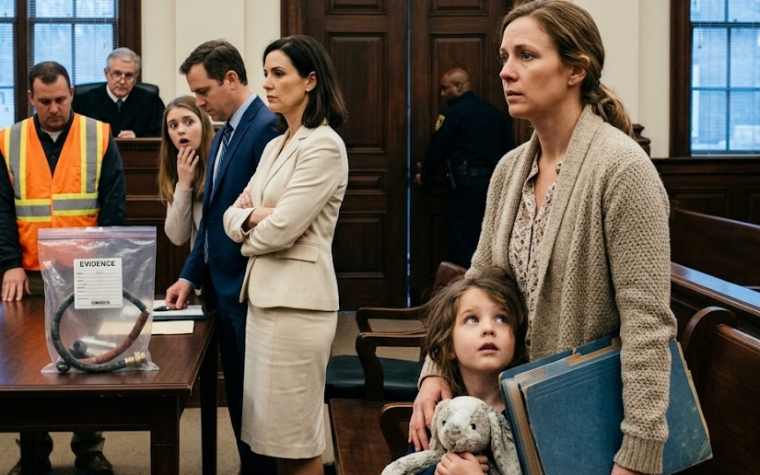
When the penthouse door was repaired, the locksmith hired by the building installed a reinforced lock and handed me the broken deadbolt in a clear evidence bag.
I kept it until the case ended.
Not as a trophy.
As a reminder.
The lock had failed, but the boundary had held.
Anthony had crossed my threshold believing he still possessed the power he had exercised throughout our marriage.
He believed he could enter my home, seize what he needed, and tell everyone I was too unstable to be believed.
Instead, the door opened onto witnesses.
The final time I saw him was at a hearing.
He looked smaller without the tailored confidence, without his mother beside him, without access to accounts that made him feel untouchable.
As he passed my table, he whispered, “You could have handled this privately.”
I met his eyes.
“You drilled through my door.”
He had no answer.