His voice had become the one I remembered from childhood—the voice that assumed volume was the final stage of authority.
I looked at the gate-control button on my screen.
Then I looked at him.
“No.”
He stared into the camera.
“I’m your father.”
“And this is my house.”
The gate remained closed.
For several seconds, the only sound through the microphone was wind moving through the trees and one of the boys asking Melissa whether they were going inside.
She didn’t answer him.
Then something shifted.
Not dramatically.
Nobody apologized.
Nobody suddenly understood me.
They simply began to realize that there was no mechanism left for turning their expectation into access.
The old code didn’t work.
The spare key didn’t work.
The garage remotes didn’t work.
I wasn’t driving up from Charlotte to negotiate.
And the handwritten accounting of my childhood wasn’t a deed.
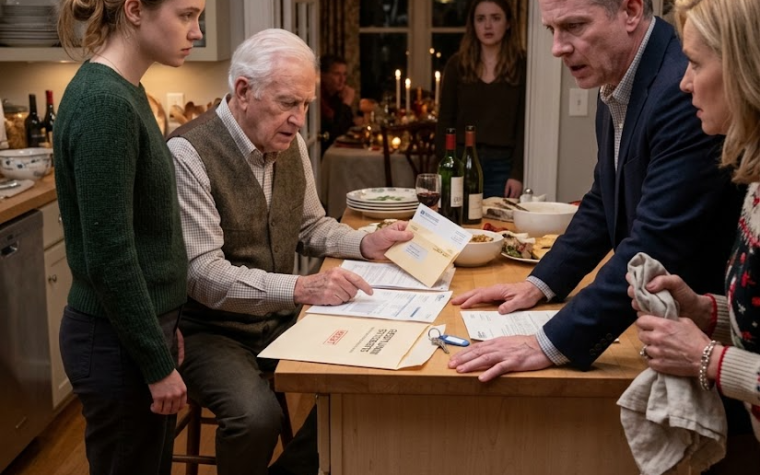
Dad picked up the envelope again.
“You’re going to regret treating your family this way.”
“Maybe,” I said.
“But you’re still not moving into my house.”
Mom tried one final time.
Her voice softened so abruptly it almost sounded like the woman who used to sit beside me when I was sick as a child.
“Honey, where is Melissa supposed to go?”
That question hurt more than Dad’s anger because it reached for the oldest lever they had.
Make the problem yours.
Make refusing the solution feel worse than creating the problem.
I watched Melissa beside the trailer she had packed before speaking to me honestly.
“I don’t know,” I said.
“But she needs to decide that without taking my home from me.”
Mom’s face hardened again.
The softness had been conditional.
Dad began loading the first bin back into the trailer.
Melissa stood still for several seconds, then joined him.
Mom didn’t help.
She remained beside the gate, looking toward the camera as though she could still shame me into pressing the button.
I didn’t.
One by one, the folding chairs disappeared.
Then the pool noodles.
Then the duffel bags.
Then the bicycles.
The ordinary objects made the whole thing feel even stranger.
They had packed sunscreen, toys, sports equipment, and household supplies for a summer in a house whose owner had never invited them to stay.
When the trailer was closed again, Dad got into the SUV.
Before Mom followed him, she looked up at the camera.
“This changes things.”
I believed her.
“I know.”
Then she got in.
The SUV pulled away first.
Melissa’s minivan followed, towing the U-Haul back down the road.
I watched until the camera feed showed nothing but the closed gate and the trees beyond it.
Only then did I realize my coffee from that morning was still sitting beside my keyboard untouched.