No distorted memory.
No family argument that had gotten slightly out of control.
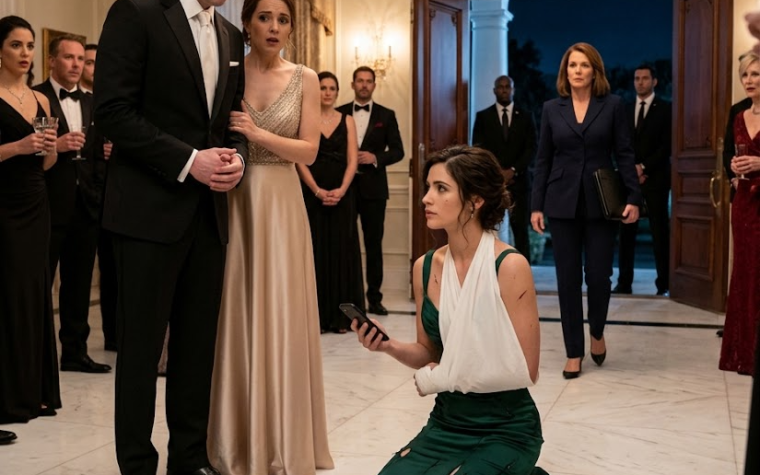
They had watched me disappear into the water while I was eight months pregnant.
The next morning, investigators came to the hospital.
Jonathan stayed with me while I gave my statement.
I told them about the baby shower, the demand for the $18,000, the punch, the water breaking, and what I remembered before losing consciousness.
Claire gave her statement separately.
Other guests did too.
The stories began lining up.
My family’s did not.
Mom went from saying she never struck me to claiming she had only shoved my shoulder.
Dad insisted his comment at the pool had been sarcasm.
Natalie said her laugh had been nervous laughter and that everyone was taking her words out of context.
But context was exactly what the recording preserved.
The demand.
My refusal.
The anger.
The fall.
Their words afterward.
By the time my parents realized there was a recording, they stopped calling my hospital room and started calling Jonathan.
He refused to discuss the evidence with them.
That was when Natalie sent me a message.
I did not answer it, but I read it once.
She said Mom had been under stress.
She said nobody intended for me to fall.
She said the family was terrified and that I was making everything worse by involving lawyers.
Then, near the end, she wrote one sentence that sounded exactly like the sister I knew.
We can fix this if you stop being selfish.
I handed the phone to Jonathan.
He read it and placed it face down.
“Your grandmother understood this pattern,” he said.
I looked at him.
“How could she know it would become this bad?”
He opened the final packet from his briefcase.
Grandma had documented years of conflict.
She had written that my mother repeatedly pressured her to divide anything intended for me with Natalie.
When Grandma refused, Mom accused her of favoritism.
Grandma did not know that someone would attack me beside a swimming pool fifteen years later.
But she had recognized something I had been trained not to see.
Whenever I possessed something Natalie did not, my family treated my ownership as a moral failure.
My grandmother had therefore arranged for the remaining portion of what she left me to be protected from anyone else’s control.
The account was modest, not some secret fortune, and much of what eventually became my $18,000 fund came from my own years of saving.
But the documents proved something more important than the amount.
The money was mine.
Legally.
Clearly.
Intentionally.
Nobody had a claim to it simply because Natalie wanted it.
And attached to those financial records was the evidence about our births.
Grandma had kept it because she feared my parents would someday use the invented twin story to convince me that everything belonging to me must automatically be shared.
“Did Natalie know?” I asked.
“Your grandmother believed your parents knew the truth,” Jonathan said.
“She was never able to establish when Natalie learned it.”
That answer hurt in a different way.
I wanted a clean villain and a clean explanation.
Instead, there were degrees of betrayal.