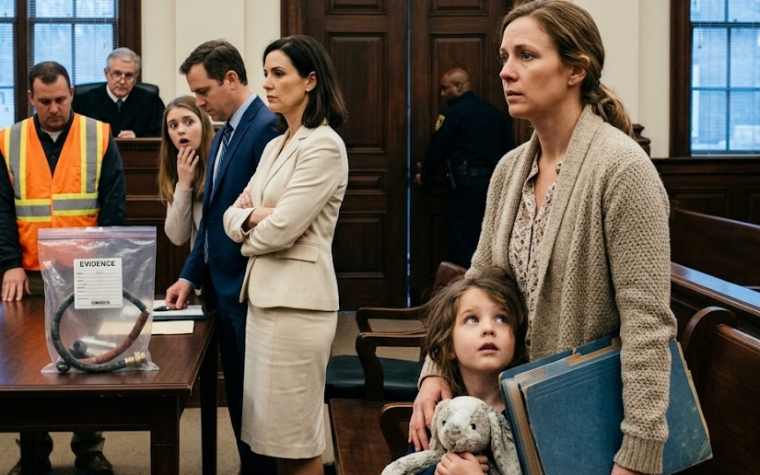
“You said this was my lesson,” I told her.
“Now give your statement.”
She was furious enough to forget the audience.
“You would have nothing without us,” she hissed.
“We raised you.
We sacrificed for you.
And the minute you make a little money, you act like a stranger.”
A woman standing near the baggage carousel looked directly at my mother, then at the evidence envelope containing the card.
My mother noticed.
Her voice dropped again.
“This can still stay inside the family.”
“It stopped being private when you used my name in five different businesses.”
The officers separated them.
I was interviewed in another room and asked to confirm each transaction.
I recognized none of them.
I signed another statement and handed over the folder I had prepared.
Through the narrow window in the door, I saw Chloe crying.
My father sat with both hands pressed between his knees.
My mother argued with an officer for nearly twenty minutes.
She kept insisting that a parent could not steal from a daughter.
The law did not share her definition of family.
They were allowed to leave the airport after questioning, but the detective kept the card and collected copies of receipts they were carrying.
The investigation moved more slowly after that, but it moved steadily.
The airline records identified all three passengers.
The resort confirmed that my mother had presented the card at check-in.
Store cameras showed her signing my name on two receipts.
Chloe had added the card to a digital wallet and used it repeatedly.
The most damaging evidence came from Chloe’s phone.
After speaking with an attorney, she agreed to provide access to messages exchanged before the trip.
In one conversation, Chloe had asked, “What if Lauren reports it?”
My mother replied, “She won’t.
She likes pretending she has boundaries, but she always pays.”
My father had responded with a thumbs-up symbol.
That message ended his claim that he knew nothing.
My mother tried several defenses.
First, she said I had gifted them the trip.
Then she said I had verbally authorized the card.
Then she said Chloe had misunderstood her.
Finally, she argued that I had manipulated the situation because I resented my sister.
Each version contradicted the one before it.
Meanwhile, the bank issued temporary credits while it investigated the disputed charges.
My credit utilization had spiked so sharply that my score dropped, but the bank provided documentation to the credit bureaus, and the damage was eventually corrected.
I changed every password, froze my credit files, replaced my account numbers, and installed a lock on the drawer where I kept financial documents.
The practical work was exhausting.
The family pressure was worse.
My aunt called and said my mother had made a terrible mistake but did not deserve public humiliation.
A cousin told me Chloe’s life could be ruined.
My grandmother asked why I could not simply let my parents repay me over time.
None of them asked how long it would have taken me to repay eighty-five thousand dollars if the bank had held me responsible.
None asked why my family had believed they could steal from me safely.
I stopped defending myself.
I sent one sentence to every relative who contacted me.
“They used my credit card without permission, and the matter is being handled through the bank and the legal system.”
Then I refused to debate it.
Three weeks after the airport confrontation, my father came to my apartment alone.
I did not let him inside.