My lawyer opened the folder, but he did not immediately remove the first document.
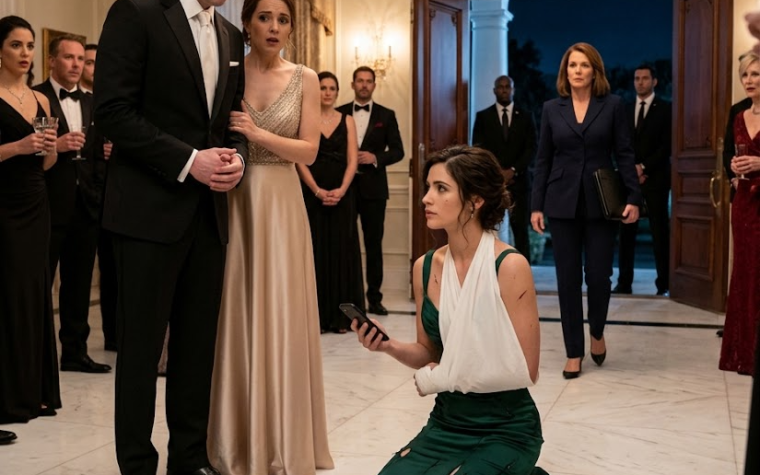
He simply placed one hand on the page and looked across the ballroom.
The laughter died so completely that I could hear the faint hum of the chandeliers.
Vanessa stood beside my wheelchair with her champagne glass frozen near her lips.
Uncle Martin took one step backward.
Daniel stared at the closed ballroom doors, where my security chief now stood with two members of his team.
No one was being threatened.
No one was trapped.
But for the first time that evening, the people who had treated my weakness as entertainment understood that they were no longer controlling the room.
Vanessa recovered first.
“What is this?” she demanded.
My lawyer, Adrian Cole, adjusted his glasses.
“A record of recent events.”
She gave a brittle laugh.
“Recent events? We are having a family gathering.”
“No,” I said.
“You are having a celebration.”
Her eyes snapped toward me.
I kept my voice low.
“You thought my life was over, and you wanted witnesses when you announced it.”
Vanessa glanced at the guests as though expecting them to defend her.
The same people who had laughed moments earlier now studied their glasses, their shoes, or the exits.
Her mother moved forward.
“This is becoming unnecessarily dramatic.”
Adrian lifted the first page from the folder.
The writing was turned away from the room, unreadable to everyone except him.
“Three days after the accident,” he said, “Vanessa requested a private meeting with two members of the company’s board.”
Vanessa’s expression changed for only a second, but I saw it.
So did Martin.
“That is not illegal,” she said quickly.
“I was worried about the company.”
“You told them I would never recover,” I replied.
“That is what the doctors said.”
“No doctor said that.”
The lie landed harder than a shout.
Adrian removed another page.
“The attending physician’s report stated that the full extent of the patient’s injuries was still being evaluated.
It made no conclusion regarding permanent paralysis.”
Vanessa tightened her grip on the champagne stem.
“You were unconscious,” she said to me.
“You do not know what I was told.”
“I know what you asked.”
I remembered waking in the hospital to the sound of her voice beyond a partially closed door.
She had not known I was conscious.
She had asked Adrian how soon a spouse could exercise authority over an incapacitated executive.
When he reminded her that we were not yet married, she had asked whether the wedding could proceed without my signature if I lacked capacity.
She had never asked whether I was in pain.
She had never asked whether I was afraid.
She had asked about voting rights, ownership, and control.
That was why I had agreed when Adrian suggested we tell the outside world only that my spinal condition remained uncertain.
My doctors disliked deception, but they understood my concern.
My security chief arranged the wheelchair, the medical transports, and the carefully controlled appearances.
We wanted to know who would remain loyal when my power appeared to be gone.
I had expected opportunists.
I had not expected almost everyone.
Vanessa set her glass on a nearby table.