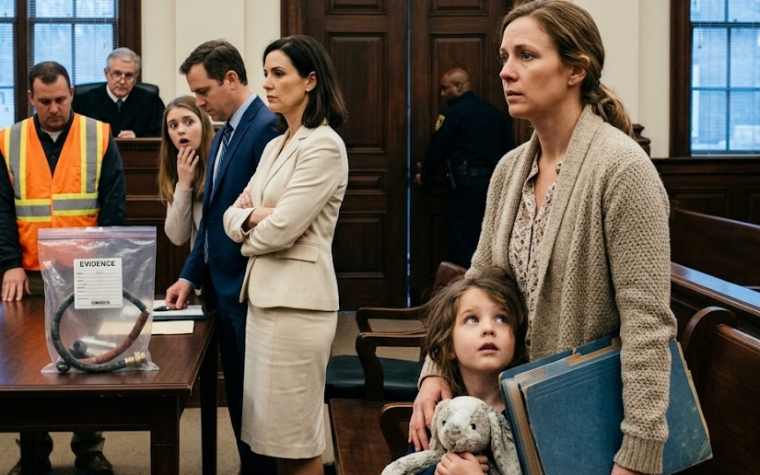
The officers showed her copies of her own messages.
Cover the marks before the gala.
Use the green concealer first.
Do not force Daniel to explain your behavior.
Remember which family pays for your life.
Evelyn called them private family conversations.
She said she had been trying to calm a difficult marriage.
She said words looked cruel when removed from context.
Then the officers played a recording from the pendant.
Her voice emerged clearly.
“If anyone asks about your neck, say you reacted badly to a skin treatment.
Daniel has investors at that dinner.
You will not embarrass him.”
My voice asked, “What if he kills me next time?”
Evelyn answered, “Then stop provoking him.”
There was no context that could repair those words.
The investigation spread quickly beyond the hospital.
Police searched the house and found damaged locks, concealed cameras, broken phones, and a drawer containing my identification documents.
Daniel had told people I was forgetful and kept losing them.
In reality, he had taken them so I could not travel, open an account, or rent a room without his permission.
Investigators also recovered the approval forms stained with my blood.
At Hale Development, accountants froze payments to the shell vendors.
The board initially released a statement expressing confidence in Daniel, but that confidence lasted less than a day.
When investigators presented matching addresses, falsified invoices, and transfers routed through the family charity, board members began hiring separate attorneys.
Daniel’s reputation had protected him because everyone assumed his success proved his honesty.
Once the evidence forced them to look, the polished image became another suspicious transaction.
His charity galas had paid companies controlled through associates.
Construction projects had been billed for materials never delivered.
Donations had moved through accounts that eventually financed private properties and political favors.
My records did not prove every crime, but they showed investigators where to look.
Daniel tried to bargain from jail.
Through his attorney, he offered me the house, a large settlement, and a quiet divorce if I withdrew my statement and described the recording as a private marital argument.
The offer reached me while I was still in the hospital.
For a moment, I stared at the number.
It was more money than I had ever controlled in my life.
Three years earlier, I might have mistaken it for freedom.
But the house was where he had locked the doors.
The money had been stolen from employees, investors, and donors.
Silence purchased with stolen money was not freedom.
It was another room he expected me to enter and lock from the inside.
I rejected the offer.
Daniel changed strategies.
He claimed I had designed the financial scheme because I was the trained accountant.
He told investigators I had manipulated him, hidden transactions, and staged the assault when he discovered my betrayal.
The accusation might have worked if I had only kept conclusions.
Instead, I had kept sequence.
Each file showed when I gained access, what I found, and how Daniel responded.
My notes included original metadata, account identifiers, and copies preserved before I annotated them.
The recordings captured him explaining which signatures he needed and threatening me when I questioned the vendors.
Most damaging of all, his own voice described the scheme.
“Those companies are walls,” he said in one recording.
“Money goes in clean, moves where I need it, and comes back cleaner.”
He had been boasting because he believed fear made me harmless.
His arrogance became the clearest witness against him.
Evelyn also tried to distance herself.
She resigned from the family charity and claimed Daniel had deceived her.