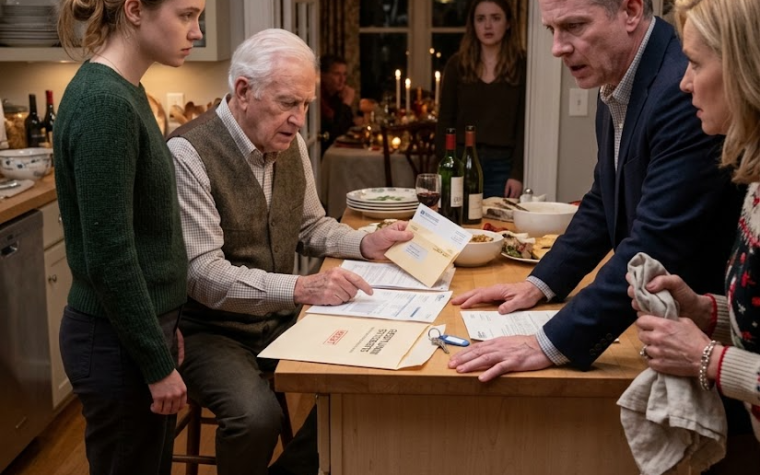
Henry threw up his hands.
“This is ridiculous.
She’s my wife.”
Dad’s voice sharpened.
“That doesn’t give you ownership of her body.”
Henry turned on him.
“This is exactly the problem.
You and Kathleen fill her head with nonsense, and suddenly I’m the villain because I expect my own wife to contribute to her family.”
I almost laughed.
The movement hurt too much.
For twenty-one days, my parents had washed my hair, spoken to doctors, reassured Emily and rearranged their lives around mine.
Henry had not brought me a glass of water.
Now he was talking about contribution.
The nurse pressed a button near the wall and asked Henry again to move away from the bed.
He did, but only after looking at me as though I had betrayed him.
That look had controlled me for years.
It told me I had embarrassed him.
It told me I had broken an invisible rule.
It told me I would pay for it later.
But as I lay there watching him, something inside me shifted.
Later was no longer guaranteed to belong to him.
Dad placed the folder on the tray table and came to my side.
“Are you all right?”
“No,” I whispered.
It was the first honest answer I had given anyone about my marriage in a long time.
Two members of hospital security arrived a moment later.
They did not storm into the room or create a spectacle.
They simply positioned themselves near the door and asked Henry to step into the hallway.
Henry refused.
“She wants me here.”
Everyone looked at me.
My stomach twisted.
This was the moment Henry had always depended on: the moment I would soften his behavior for him.
The moment I would say it was a misunderstanding.
The moment I would rescue him from the consequences of what he had just done.
I looked directly at the security officer.
“I want him to leave.”
Henry stared at me.
“Amy, think about what you’re doing.”
“I am.”
“You’re going to turn our family upside down over an argument?”
Dad moved between Henry and my bed.
“No,” I said.
“You did that when you tried to drag me out of a hospital bed.”
For several seconds, Henry said nothing.
Then his anger returned all at once.
He pointed at the folder.
“You think because your father filled out a few forms, he gets to make decisions for my family?”
Dad opened it.
“No,” he said.
“Amy does.”
That sentence silenced the room.
I looked at my father.
For years, I had allowed Henry to describe every decision as something he permitted or refused.
Where we went.
What I bought.