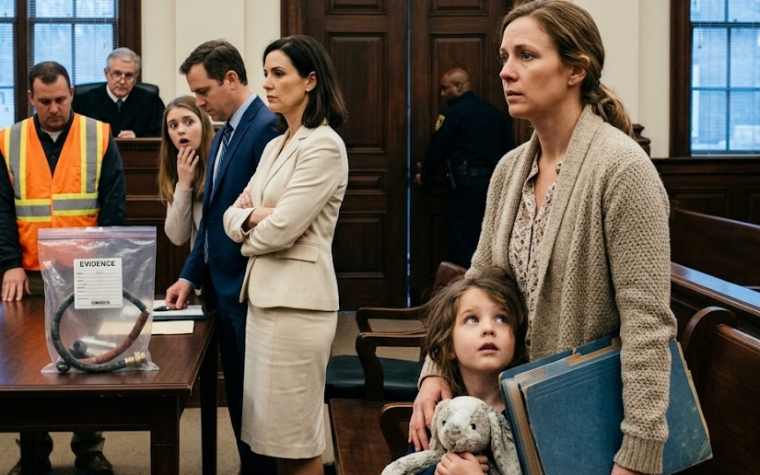
She stared at him.
The confidence she’d worn into court was gone.
“You told me Claire was paranoid,” she said.
“You told me she invented things because she couldn’t handle you leaving her.”
Daniel’s attorney closed his eyes.
“Ms.
Reed,” Judge Whitaker warned, “this is not the time for an argument between witnesses.”
Vanessa nodded, but tears had already filled her eyes.
I expected to feel satisfaction.
I didn’t.
Vanessa had helped destroy my marriage, but in that moment she looked less like a victor and more like someone realizing she’d bought a ticket onto a sinking ship.
The judge temporarily recessed the hearing while the new material was examined.
Rachel took me into a consultation room.
My knees were shaking.
“I still don’t want the house,” I told her.
“This isn’t about the house anymore.”
“It was never about the house.”
She studied me.
Then she nodded.
I finally told her the sentence I hadn’t been able to say aloud before court.
“I’m afraid of what Daniel will do when the baby comes.”
Rachel’s face softened, but her answer was practical.
“Then we make sure the court understands that clearly.”
When we returned, two additional officials were waiting near the back of the courtroom.
Daniel noticed them immediately.
His arrogance had turned into frantic calculation.
He whispered to his lawyer.
His lawyer shook his head.
Judge Whitaker took the bench.
She did not announce dramatic conclusions.
Real courtrooms rarely work that way.
Instead, she did something that frightened Daniel more.
She slowed everything down.
She suspended the final property ruling.
She ordered full disclosure of accounts connected to Daniel’s business after preliminary records suggested payments involving Emily and Lily had never appeared in the financial statements submitted during our divorce.
She directed that the newly produced evidence be preserved and referred to the proper authorities for evaluation.
And because of the allegations now before the court—combined with evidence Rachel had already filed—she granted temporary protective conditions governing Daniel’s contact with me while my pregnancy continued.
Daniel stared at the judge.
“You can’t punish me because a child walked in here with a toy.”
Judge Whitaker’s answer was quiet.
“I’m not punishing you, Mr.
Caldwell.
I’m preserving evidence and protecting people while facts are determined.
You would be wise to understand the difference.”
That silenced him.
But only for a moment.
As the hearing continued, the outline of Emily Mercer’s story emerged through records rather than spectacle.
Years earlier, she had worked with Daniel when his company was much smaller.
Their relationship became personal.
When she became pregnant, Daniel initially acknowledged Lily privately.
He paid money irregularly and insisted the arrangement remain secret.
Over time, according to the material Emily preserved, those payments became leverage.
If Emily challenged him, money stopped.
If she threatened formal proceedings, Daniel reminded her that his attorneys were better than anything she could afford.
If she dated someone, he accused her of exposing Lily to danger.
He demanded access when it suited him and disappeared when responsibility became inconvenient.