It was also mine to handle without selling my daughter’s future to people who had treated her illness like leverage.
The leather folder became a different problem.
Mr.
Ellison contacted me the next morning.
His tone was formal.
He told me he would not be assisting Harold or Patricia with any transfer involving the trust.
He also confirmed that the documents should be preserved exactly as they existed that night.
I obtained independent legal advice and made a formal record of what had happened at the hospital.
The nurse gave her account.
Hospital records confirmed the timing: Ava’s emergency admission, the surgery preparation, the arrival of my in-laws, and the period during which the documents were signed.
The papers supplied the rest.
The most damaging parts were not my signatures.
They were the statements Harold and Patricia had wanted my signatures to legitimize.
One page claimed the arrangement was voluntary.
Another represented that the property was mine to transfer personally.
Another described consideration as though it were an ordinary negotiated business exchange rather than money offered in the middle of a child’s medical emergency.
Their attempt to make the transaction look clean was exactly what made it look worse.
When Patricia learned that I had preserved the documents, she called me.
I answered once.
“You are destroying this family,” she said.
I stood in my kitchen with Ava’s antibiotic schedule taped beside the refrigerator.
“No, Patricia.
I was at the hospital trying to keep my family alive.”
“We were trying to help you.”
“You asked for Ava’s home.”
Silence.
“You asked for the company that supports her.”
Another silence.
“And you did it while she was waiting for surgery.”
Patricia’s voice hardened.
“Daniel would be ashamed of you.”
That used to be the sentence that could wound me faster than anything else.
This time, I looked across the kitchen at a photograph of Daniel holding newborn Ava against his chest.
“Daniel created that trust,” I said.
“You should think about why.”
Then I ended the call.
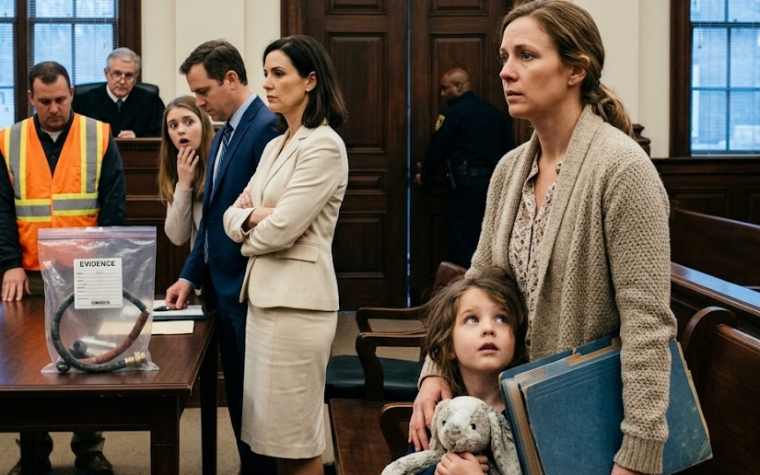
The dispute did not turn into the dramatic courtroom spectacle Harold seemed to expect.
Once the trust documents were reviewed, there was no serious argument that the house or controlling company interest had transferred to them.
Their papers were legally useless for the purpose they had intended.
The more serious issue became the circumstances under which they had tried to obtain my signature.
Authorities reviewed the matter.
Their lawyers argued that it had been an aggressive financial proposal between relatives.
My side presented it as something far darker: an attempt to obtain valuable assets by exploiting a parent’s fear during her child’s emergency treatment and dressing the transaction in declarations that did not reflect reality.
Months passed.
Eventually, Harold and Patricia accepted a negotiated legal resolution that included formal restrictions on contacting me about the trust assets and consequences tied to their conduct surrounding the attempted transfer.
They were warned that any further interference with Ava’s trust, my management of the company, or our home would bring immediate additional action.
The exact legal language mattered less to me than one simple fact.
They could not do it again.
Mr.
Ellison never represented another attempt to take the house or business.
The company stayed where Daniel had intended it to stay.
I kept running it.
At first, walking into the office after Ava’s surgery felt strange.
Harold had spent those two hours in the hospital waiting room talking about replacing people and taking control.
For weeks afterward, I heard his voice whenever I unlocked the door.
Then ordinary life slowly drowned him out.