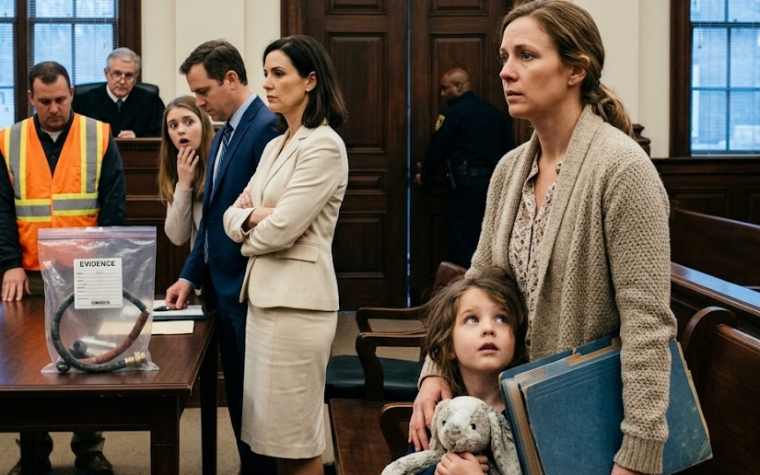
“Linda Dawson?” the attorney repeated.
“Before anyone carries another box into this house, we need to discuss the recorded deed.”
My mother stared at him as though he had walked into the wrong yard.
Mark still had one of Kendra’s moving boxes balanced against his hip.
Kendra stood behind him on the porch, one hand gripping the railing.
Across the street, Mrs.
Bell had abandoned all pretense of not watching.
Mom recovered first.
“I don’t know who you are,” she said, drawing herself upright, “but this is a family matter.”
The man beside me closed the folder halfway.
“My name is Daniel Hale.
I represent Ava.”
That sentence changed the temperature of the entire yard.
Kendra looked at me.
“You hired a lawyer?”
I rested my keys against my palm.
“A month ago.”
Mom gave a short laugh, but it sounded forced.
“For what? She doesn’t have any rights here.
This was her father’s house.”
Daniel looked at me once, silently asking whether I wanted him to continue.
I nodded.
He opened the folder again.
“That,” he said calmly, “is exactly why Ms.
Dawson asked me to verify the property records before taking any action.”
Mom’s expression tightened.
For years, she had spoken about the house as though saying “our house” often enough made every legal question irrelevant.
Dad had handled paperwork.
Dad had handled financing.
Dad had handled the things nobody discussed at dinner.
After he became ill, I had started helping him.
That was the part Kendra never saw.
During the final year of Dad’s life, there were nights when I would sit beside his bed with my laptop while he sorted medical statements, insurance notices, mortgage letters, and tax documents into uneven piles.
He hated being dependent on anyone.
“I built my whole life around taking care of everybody,” he told me once.
“Funny how quickly people stop asking who’s taking care of the person doing the carrying.”
I had told him not to worry about the house.
I would handle the payments until he recovered.
He never did.
But before his condition worsened, Dad had made decisions about the property that nobody else in the family had bothered to understand.
Years earlier, when financial problems threatened the house and Mom wanted nothing to do with the details, I had stepped in.
I contributed money, assumed responsibility for payments, and worked with Dad to keep the property from slipping away.
The arrangement was formalized.
Dad signed the required documents, and the ownership records were updated.
He explained it to me plainly.
“You’re the one keeping this place standing, Ava.
Your name needs to reflect that.”
I had never used that fact against my mother.
After Dad died, I let her remain in the house without demanding anything from her.
She was grieving.
So was I.
The last thing I wanted was to wave documents around while we were choosing flowers for a funeral.
Months became years.
I paid what needed paying.
Mom gradually stopped treating my help as help.
Then she began treating it as an obligation.